
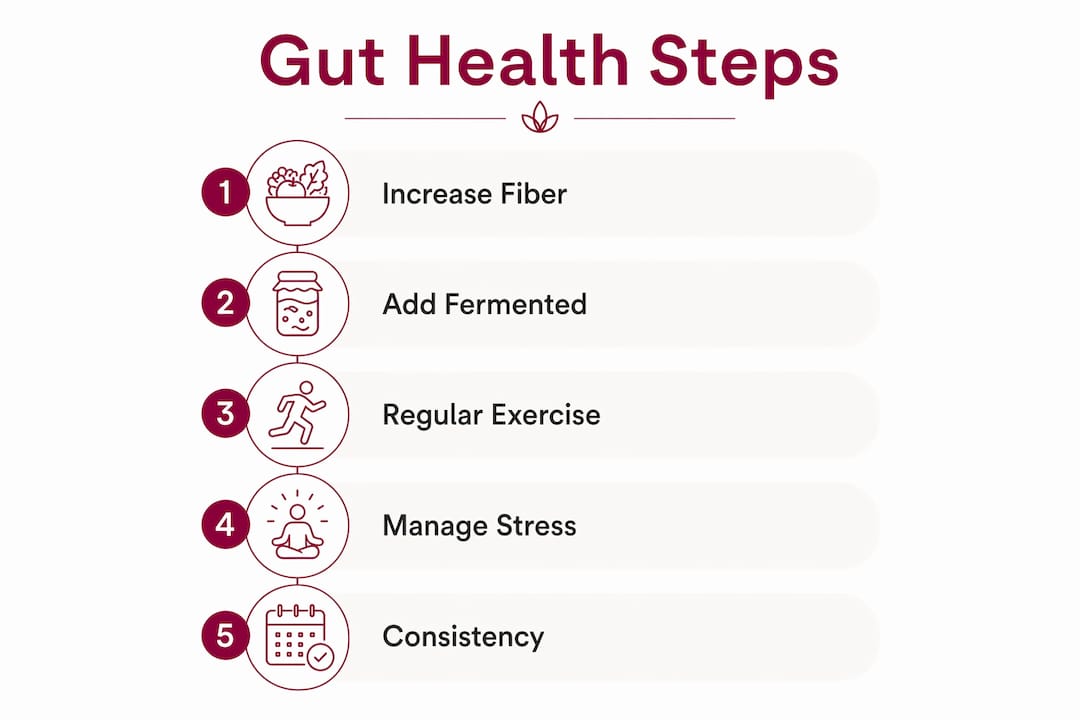
Improving gut health naturally means feeding your gut microbiome with fiber, fermented foods, and consistent lifestyle habits that support bacterial diversity and digestive function. The gut microbiome, the community of trillions of bacteria living in your digestive tract, responds directly to what you eat, how you move, and how well you manage stress. Small, deliberate changes produce real results. Women need 25–28g of fiber daily, men need 30–38g, and even a modest 6g daily increase produces measurable microbiome benefits. This guide covers the four core pillars: fiber, fermented foods, stress management, and exercise, with practical steps you can start this week.
How does dietary fiber improve gut health naturally?
Dietary fiber is the single most effective food-based tool for supporting a healthy gut microbiome. Fiber feeds gut microbes, which ferment it into short-chain fatty acids. Those fatty acids strengthen the gut lining, reduce inflammation, and support immune function throughout the body.
The 2026 fiber intake targets are clear: women need 25–28g per day, men need 30–38g. Most adults fall well short of these numbers. The good news is that you do not need to hit the full target immediately. Adding just 6g of fiber daily yields measurable gut microbiome improvements, which makes the goal feel far more manageable.
Plant variety matters as much as total fiber quantity. Eating 30 different plants weekly correlates with significantly greater microbial diversity compared to eating fewer than 10. That diversity is what makes a microbiome resilient. A diverse microbiome handles stress, illness, and dietary changes far better than a low-diversity one.

Pro Tip: Count plants, not just servings. Herbs, spices, nuts, seeds, legumes, fruits, and vegetables all count toward your 30 weekly plants. A sprinkle of mixed seeds on oatmeal adds three or four plant types in one move.
Strong fiber sources to rotate through your weekly meals:
- Legumes: lentils, black beans, chickpeas
- Whole grains: oats, barley, farro, brown rice
- Vegetables: broccoli, artichokes, leeks, sweet potato
- Fruits: raspberries, pears, apples with skin
- Nuts and seeds: flaxseed, chia seeds, almonds, walnuts
One common mistake is increasing fiber too fast. Rapid fiber increases cause bloating, gas, and discomfort because your gut bacteria need time to adapt. Add one new high-fiber food per week and drink plenty of water alongside it. Gradual introduction gives your microbiome time to recalibrate without the discomfort that makes people quit.
What fermented foods and natural probiotics support gut health?
Fermented foods introduce live bacteria directly into your digestive tract. They increase microbial diversity in a way that fiber alone cannot. The most accessible options are plain yogurt, kefir, kimchi, sauerkraut, miso, and tempeh. Each contains distinct bacterial strains that contribute to a more varied microbiome.
A study found that gradually increasing fermented food intake to six servings per day over 10 weeks improves gut bacterial diversity and reduces markers of inflammation. That is a meaningful result. It also confirms that the key word is “gradually.” Jumping straight to six servings daily can disrupt your gut just as much as ignoring fermented foods entirely.
| Food | Live cultures | Ease of use |
|---|---|---|
| Plain yogurt | Yes | High |
| Kefir | Yes | High |
| Kimchi | Yes | Medium |
| Sauerkraut | Yes | Medium |
| Tempeh | Yes (if raw) | Medium |
| Miso | Yes (if unpasteurized) | High |
Probiotic supplements are a different category. They can help, but only when chosen correctly. Probiotic strains are specific: a supplement labeled “Lactobacillus” tells you almost nothing useful. You need the full strain name, the CFU count, and confirmation that the product requires proper refrigeration if the strain demands it. A poorly stored or mislabeled supplement delivers little to no benefit.
Pro Tip: Start with one tablespoon of sauerkraut or kimchi per day alongside a meal. Build up over two to three weeks before adding a second serving. Your gut bacteria need time to welcome new microbial neighbors.
For readers curious about how fermented drinks support the microbiome, kombucha fits naturally into this category as a low-sugar, live-culture beverage option.
How do lifestyle factors like stress, exercise, and fasting affect gut health?
Diet is only part of the picture. Stress, physical activity, and eating patterns each shape your gut microbiome in ways that food alone cannot fix.
Stress has a direct biological effect on digestion. Your gut contains its own nervous system, called the enteric nervous system, which communicates constantly with your brain. When stress activates your fight-or-flight response, gut sensitivity increases and digestion slows. Calming practices like mindful walking and slow breathing before meals help regulate this system. These are not soft wellness suggestions. They are physiologically grounded habits.
Four lifestyle practices that support gut microbiome balance:
- Exercise regularly. Aim for at least 150 minutes of moderate activity per week. Walking, cycling, and swimming all count. Exercise increases microbial diversity independent of diet.
- Practice overnight fasting. A 12-hour fasting window overnight, such as finishing dinner by 8 p.m. and eating breakfast after 8 a.m., gives your gut time to rest and repair.
- Manage stress daily. Even five minutes of slow breathing before a meal reduces enteric nervous system activation and improves digestion.
- Prioritize sleep. Poor sleep disrupts the gut-brain axis and reduces microbial diversity. Seven to nine hours supports both gut and overall health.
“Simple, consistent stress-relief activities can biologically benefit digestion by calming the gut’s own nervous system.”
Ultra-processed foods deserve a specific mention here. Ultra-processed foods reduce gut bacteria diversity, which undermines the resilience you are working to build. Cutting back on packaged snacks, fast food, and artificially flavored drinks is a lifestyle change with direct microbiome consequences. It is not about perfection. It is about reducing the frequency.
What are the best practical steps to start improving gut health naturally?
The most common reason people fail at gut health changes is doing too much at once. A stepwise approach protects you from digestive discomfort and makes the habits stick.
| Week | Action |
|---|---|
| Week 1 | Add one high-fiber food daily (e.g., oats, lentils, or an apple with skin) |
| Week 2 | Introduce one fermented food serving per day (e.g., plain yogurt or sauerkraut) |
| Week 3 | Begin a 12-hour overnight fasting window and add 30 minutes of walking three times per week |
| Week 4 | Add a second fermented food serving and track your weekly plant variety toward 30 types |
| Week 5+ | Gradually increase fiber toward daily targets and fermented servings toward six per day |
Common mistakes to avoid:
- Adding too much fiber too fast, which causes bloating and discourages continuation
- Relying on probiotic supplements without checking strain names and CFU counts
- Eating ultra-processed foods regularly while trying to build microbiome diversity
- Skipping stress management and sleep, which undercut every dietary effort
- Expecting fast results. Gut microbiome changes take weeks to months to show up clearly
Pro Tip: Keep a simple weekly plant tally on your phone’s notes app. Aim to add at least two new plant types each week. Variety, not volume, is the goal.
Tracking your plant diversity is one of the most underused natural gut health tips. Most people focus on what they eat in a single meal rather than the variety they consume across a full week. Shifting that perspective changes the game. A week with 30 plant types looks very different from a week with 8, even if the calorie count is identical.
For a deeper look at probiotic-rich beverage options that fit into this kind of gradual approach, fermented drinks like kombucha offer a convenient daily serving of live cultures without the prep work of making kimchi or kefir from scratch.
Key Takeaways
The most effective way to improve gut health naturally combines gradual fiber increases, daily fermented foods, regular exercise, and consistent stress management, with patience as the non-negotiable ingredient.
| Point | Details |
|---|---|
| Fiber is foundational | Women need 25–28g daily, men 30–38g; even 6g more per day improves microbiome health. |
| Plant variety drives diversity | Eating 30 different plant types weekly produces significantly greater microbial diversity. |
| Fermented foods work gradually | Build to six daily servings over 10 weeks for measurable diversity and inflammation benefits. |
| Lifestyle habits matter as much as diet | 150 minutes of weekly exercise and a 12-hour overnight fast both support gut microbiome balance. |
| Pace your changes | Introducing fiber and fermented foods too fast causes discomfort and derails progress. |
What I have learned from years of watching gut health advice come and go
Most gut health content focuses on what to add: more fiber, more probiotics, more supplements. What gets far less attention is the pace at which you add things. I have seen people load up on psyllium husk, kefir, and a probiotic supplement in the same week and then give up entirely after three days of bloating. The gut is not a machine you can upgrade overnight. It is a living ecosystem that needs time to adjust.
The research on fermented foods and microbiome science keeps reinforcing something I believe strongly: whole food sources outperform supplements in most cases. A supplement gives you one or two strains. A bowl of kimchi, a glass of kefir, and a handful of mixed seeds give you dozens of microbial inputs alongside fiber, polyphenols, and nutrients that work together in ways no capsule can replicate.
I also think stress management is the most underrated gut health intervention available. People treat it as optional, a nice-to-have alongside the real work of diet. But the enteric nervous system responds to chronic stress in ways that no amount of fiber can fully counteract. A person eating 35g of fiber daily while running on cortisol and poor sleep will still struggle with digestion. The body does not compartmentalize that neatly.
My honest advice: pick one change per week, track how your body responds, and adjust from there. The readers who see the best long-term results are not the ones who overhaul everything at once. They are the ones who stay curious, stay consistent, and give their gut the time it actually needs.
— Luna
Aboocha’s fermented beverages for your gut health routine

Aboocha crafts low-sugar, flavor-forward kombucha beverages designed specifically for people who take gut health seriously. Each bottle delivers live cultures in a form that fits naturally into the gradual approach this article recommends: one daily serving of a fermented drink is a simple, consistent way to add beneficial bacteria without overhauling your entire diet. Flavors like Sour Plum and Yuzu Osmanthus make the habit genuinely enjoyable, which is what keeps people consistent. Aboocha’s kombucha bundles let you build a weekly rotation of flavors, supporting both microbiome diversity and daily routine. For something special, the Aboocha x Deefruit collaboration brings together natural fermented ingredients in a pairing worth trying.
FAQ
How long does it take to improve gut health naturally?
Measurable microbiome changes typically appear within four to ten weeks of consistent dietary and lifestyle adjustments. Gradual increases in fiber and fermented foods produce the most sustainable results.
What foods support gut health the most?
High-fiber plants, fermented foods like yogurt, kefir, kimchi, and sauerkraut, and a wide variety of at least 30 different plant types per week are the strongest food-based tools for gut microbiome health.
Are probiotic supplements better than fermented foods?
Fermented foods generally outperform supplements because they deliver multiple bacterial strains alongside fiber and nutrients. Supplements can help, but only when the strain name, CFU count, and storage requirements are verified on the label.
Does exercise really affect gut health?
Yes. At least 150 minutes of moderate exercise per week increases gut microbial diversity independent of diet. Physical activity is one of the most direct non-dietary ways to support a healthy microbiome.
Can stress damage your gut health?
Chronic stress activates the enteric nervous system and increases gut sensitivity, which disrupts digestion and reduces microbial balance. Simple daily practices like slow breathing before meals help regulate this response biologically.