
Your gut is home to trillions of microorganisms that don’t just coexist with you. They work for you. What is symbiotic gut health? At its core, it describes the mutually beneficial relationship between your body and the microbial community living in your digestive tract. Scientists call this relationship symbiosis, and when it functions well, it shapes everything from how you digest food to how your immune system responds to threats. This article breaks down the science, separates real terminology from popular buzzwords, and gives you practical ways to support your gut ecosystem every day.
Table of Contents
- Key takeaways
- What symbiotic gut health actually means
- How your gut microbiome shapes your health
- What research says about synbiotics
- Practical ways to support your gut ecosystem
- Common misconceptions about gut health
- My honest take on gut health as a lifelong practice
- Support your gut with Aboocha kombucha
- FAQ
Key takeaways
| Point | Details |
|---|---|
| Symbiosis is the foundation | Your gut microbiome and your body evolved together in a mutually beneficial relationship that drives digestion and immunity. |
| Synbiotics are a defined category | The scientific term for a probiotic plus prebiotic combination is “synbiotic,” defined by the ISAPP expert panel. |
| Research shows specific gains | Synbiotic interventions increase beneficial bacteria and short-chain fatty acids, though effects on inflammation markers are limited. |
| Diet and movement matter most | Fiber-rich foods and regular exercise are the most evidence-backed ways to maintain a thriving gut ecosystem. |
| No single supplement fixes everything | Long-term dietary consistency outperforms any one-off gut health product or quick-fix protocol. |
What symbiotic gut health actually means
The phrase “symbiotic gut health” is widely used in wellness circles, but it is not a formal scientific term. The recognized term for a product that combines live microorganisms with substrates they can use is a synbiotic. The ISAPP expert panel defines a synbiotic as a mixture of live microorganisms and selectively utilized substrates that confers a health benefit on the host. Understanding both terms matters if you want to make smart choices about your gut.
Symbiosis vs. synbiotics: a quick breakdown
- Symbiosis in digestive health refers to the broader, naturally occurring partnership between your body and gut microbes. It developed over millions of years of co-evolution.
- Synbiotics are a product category: a deliberate combination of probiotics and prebiotics designed to work together.
- Complementary synbiotics pair a proven probiotic with a proven prebiotic that work independently.
- Synergistic synbiotics use a prebiotic substrate specifically selected to feed the accompanying probiotic strain, maximizing effect.
The ISAPP consensus also clarifies that synbiotics do not require separate proof that each ingredient works alone. The combination itself can demonstrate the benefit. That distinction opens the door for genuinely new formulations.
Pro Tip: When reading product labels, look for the specific probiotic strain name (like Lactobacillus rhamnosus GG, not just “Lactobacillus”) and a named prebiotic source like inulin or FOS. Vague labeling is a reliable sign of a weak product.
The ISAPP 2026 gut health consensus defines gut health itself as the presence of normal gastrointestinal function, absence of disease, and no quality-of-life-affecting symptoms. That definition matters because it moves gut health beyond subjective feeling into measurable physiological territory.
How your gut microbiome shapes your health
The human gut is not just a digestion machine. Its microbial interface spans roughly 250 to 400 square meters of surface area, and it interacts with almost every system in the body. Understanding the gut microbiome means recognizing it as a metabolically active organ in its own right.
The gut’s key jobs beyond digestion
Your gut microbiota do far more than break down food. Here is what the science shows they are actively doing:
- Breaking down dietary fiber into short-chain fatty acids (SCFAs) like butyrate, propionate, and acetate
- Producing neurotransmitters including serotonin and GABA, which directly influence mood and cognition via the gut-brain axis
- Training and modulating the immune system, which has roughly 70% of its cells located in gut-associated tissue
- Protecting the intestinal lining from pathogens by competing for space and nutrients
SCFAs from fiber fermentation promote intestinal barrier integrity, regulate energy metabolism, and keep inflammation in check. When the gut barrier weakens, bacterial byproducts can enter the bloodstream. That process, sometimes called “leaky gut,” is linked to systemic inflammation and a range of chronic conditions.
What happens when balance breaks down
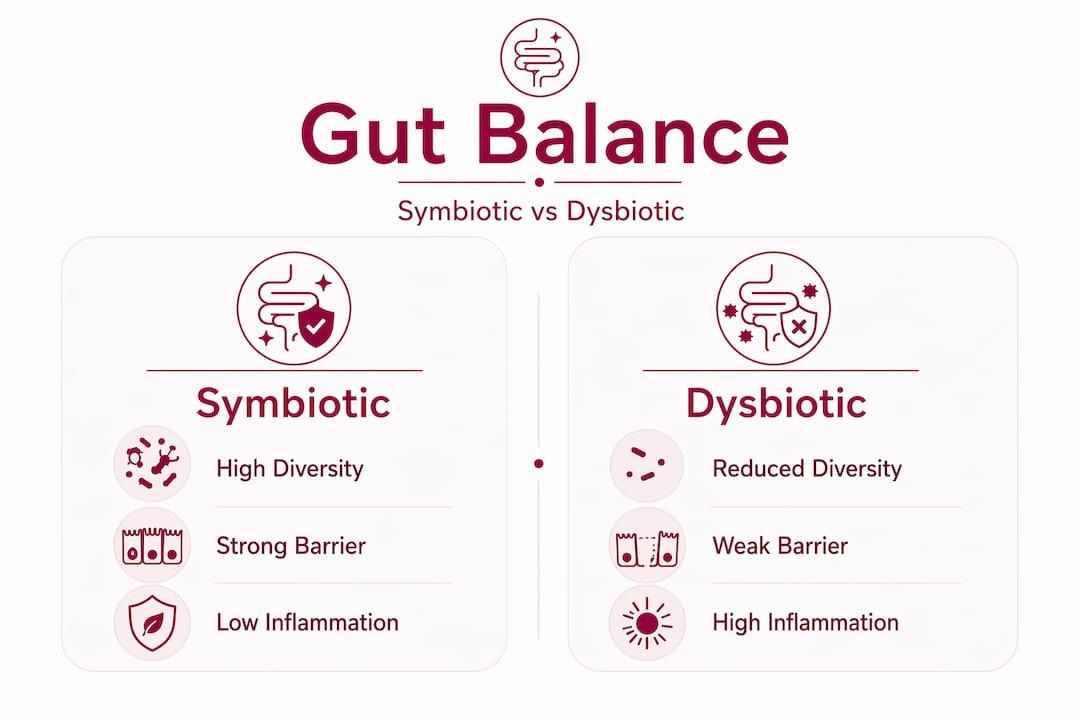
The opposite of a thriving microbial ecosystem is dysbiosis, which is a state where harmful microbes outnumber or outcompete beneficial ones. Dysbiosis is associated with irritable bowel syndrome, obesity, type 2 diabetes, and mood disorders. The key insight here is that diversity in your microbial community acts as a buffer. A diverse microbiome can recover from disruption. A low-diversity one cannot.

| Balanced microbiome | Dysbiotic microbiome |
|---|---|
| High microbial diversity | Reduced diversity |
| Strong gut barrier function | Increased intestinal permeability |
| Efficient SCFA production | Reduced metabolite output |
| Regulated immune response | Elevated systemic inflammation |
What research says about synbiotics
The appeal of synbiotic supplements is obvious. You take a capsule and get both probiotics and their fuel in one shot. But what does the actual research say?
A meta-analysis of 16 clinical studies found that oral synbiotic supplementation in healthy adults significantly increased Lactobacillus counts (SMD 0.74) and propionate concentrations (SMD 0.22). Those are meaningful numbers. More Lactobacillus means more competition against harmful bacteria, and higher propionate supports gut barrier health and appetite regulation.
Here is what the same research found less compelling: synbiotics did not consistently reduce inflammatory markers like IL-6, C-reactive protein, or circulating endotoxins in healthy adults. That does not mean synbiotics fail. It means their measurable benefits may be more microbiome-specific than system-wide, at least in people who are already healthy.
- Effects vary significantly by strain. A synbiotic built around Lactobacillus acidophilus behaves differently from one built around Bifidobacterium longum.
- The prebiotic substrate matters. Inulin, FOS, and GOS each feed different microbial populations.
- Synbiotics are not interchangeable. Their function depends on the specific strain-prebiotic pairing and your existing gut ecology.
- Short-term supplementation may shift microbial populations without translating to measurable clinical outcomes.
Pro Tip: If you are trying a synbiotic supplement, give it at least eight weeks before evaluating results. Microbial shifts take time to stabilize, and short-term trials rarely capture the full effect.
The practical takeaway is that synbiotics work best as part of a broader dietary strategy. They are a support tool, not a replacement for the diet that feeds your microbiome daily.
Practical ways to support your gut ecosystem
The good news about symbiosis in digestive health is that you do not need a prescription to support it. Your daily choices are your most powerful lever.
-
Eat more fiber, and vary the sources. Diet mediates microbiome effects across multiple body systems. Different fibers feed different microbial species. Rotate between legumes, oats, vegetables, fruits, and whole grains to build real diversity. Aim for 25 to 38 grams per day, and consider plant-based food groups as a reliable framework for hitting that target.
-
Move consistently, not just occasionally. 150 to 270 minutes per week of moderate to high intensity exercise improves gut microbiota diversity and regularity. Walking counts. So does cycling, swimming, or any sustained activity you will actually do.
-
Add fermented foods to your weekly routine. Foods like yogurt, kefir, kimchi, miso, and kombucha deliver live microorganisms along with organic acids that support the gut environment. You can learn how fermented foods reduce bloating through the microbial changes they trigger in your digestive tract.
-
Reduce your intake of ultra-processed foods. These products are low in fiber and high in emulsifiers and additives that disrupt microbial balance. Swapping even one processed snack per day for a whole food option adds up over months.
-
Manage stress and sleep. The gut-brain axis runs in both directions. Chronic stress and poor sleep alter microbial composition in ways that compound over time. Sleep deprivation alone has been shown to reduce Bifidobacterium counts.
Pro Tip: Your gut microbiome responds to consistent dietary patterns far more than to sporadic interventions. One week of clean eating does not undo months of a low-fiber diet. Consistency, not perfection, drives lasting results.
Common misconceptions about gut health
The wellness industry has turned “gut health” into a marketing phrase that gets attached to almost any food or supplement. Here is where popular claims diverge from what science actually supports.
- “Symbiotic gut health” is not a clinical term. It describes a concept. When you see it on a product label, ask whether the company is citing the ISAPP-defined synbiotic standard or simply using appealing language.
- Not all probiotics are equal. Strain specificity is everything. A product with a billion CFUs of an unspecified Lactobacillus species is not the same as a clinically studied strain. Specific strain combinations determine what a synbiotic actually does.
- There is no all-in-one gut fix. No single supplement replaces dietary diversity, physical activity, and consistent sleep. Products that claim otherwise are overpromising.
- Probiotic supplements alone may not colonize your gut long-term. Most transient strains pass through without permanently altering your microbiome. Their benefits often depend on continued intake alongside a supportive diet.
The clearest path forward is a holistic approach that treats diet, movement, sleep, and targeted supplementation as parts of a whole, not competing options.
My honest take on gut health as a lifelong practice
I have spent years reading the research on gut health and watching people chase every new supplement that promises transformation in thirty days. Here is what I have found to be true: the gut is not a problem to solve. It is a system to maintain.
What strikes me about the current science is how much it validates common sense. Eat real food. Move your body. Sleep. But the research adds nuance that actually changes behavior. When I understood that individual baseline microbiomes vary so much that a dietary change helping one person may do nothing for another, I stopped giving one-size-fits-all advice. I started asking people what their consistent patterns looked like, not what they did last week.
The emerging research on synbiotics is genuinely exciting, but my honest read is that the gap between “this shifts microbial populations” and “this meaningfully improves your health” is still being closed. The science is ahead of the marketing, which is the right order. What I tell people is this: build the dietary foundation first. Fermented foods, fiber, exercise. Then, if you want to layer in a targeted synbiotic, you are actually giving it something to work with.
Gut health is not a destination. It is a direction. And every consistent choice you make pushes you further along it.
— Luna
Support your gut with Aboocha kombucha
If fermented beverages interest you as part of a gut-friendly routine, Aboocha’s kombucha lineup is worth exploring. Each bottle goes through a live fermentation process that generates organic acids and beneficial microorganisms, and Aboocha keeps sugar content lower than most commercial options so you get the probiotic benefit without the glucose spike. Their kombucha fermentation process is also transparent and well-documented for curious readers.
The Passionfruit Mint Kombucha is a crisp, refreshing starting point, especially if you are new to kombucha. For something more unexpected, the Sour Plum Kombucha delivers a bold flavor profile that pairs well with meals. Both fit naturally into the daily fermented food habit the research recommends. Aboocha also offers subscription plans, which removes the friction of restocking and keeps your gut-health routine consistent.
FAQ
What is symbiotic gut health in simple terms?
Symbiotic gut health describes the mutually beneficial relationship between your body and the trillions of microbes living in your digestive tract. When this relationship is balanced, it supports digestion, immunity, and overall wellness.
What is the difference between symbiotic gut health and synbiotics?
Symbiotic gut health is a descriptive concept referring to the natural partnership between host and gut microbiome. A synbiotic is a specific product category, defined by the ISAPP as a combination of live microorganisms and prebiotic substrates that together confer a health benefit.
What affects gut health the most?
Diet has the strongest documented influence on gut health, particularly fiber intake. Physical activity, sleep quality, stress levels, and antibiotic use also significantly shape the composition and function of your gut microbiome.
Do synbiotic supplements actually work?
Research shows synbiotics can increase beneficial bacteria like Lactobacillus and raise propionate levels in healthy adults, but effects on inflammatory markers are limited. Results depend heavily on the specific strains and prebiotic substrates used in the product.
How do fermented drinks like kombucha support the gut?
Kombucha delivers live microorganisms and organic acids produced during fermentation. These contribute to the gut environment by introducing beneficial microbes and supporting the conditions in which existing gut bacteria thrive.