
For most people with active acid reflux, kombucha is more likely to aggravate symptoms than ease them, largely because of its natural acidity and carbonation. Mild, well-managed cases may tolerate a few ounces with food, but the probiotic benefits often cited for gut health don’t have solid trial evidence for reflux specifically. If your symptoms are moderate to severe, talk to a doctor before experimenting.
TL;DR:
- Kombucha’s acidity and carbonation can trigger reflux symptoms, especially in those with moderate to severe GERD or esophagitis.
- Longer fermentation, higher caffeine content, residual sugar, and bottle conditioning increase acidity, fizz, and potential reflux triggers.
- Evidence specifically supporting kombucha for reflux is limited; targeted probiotic strains have shown promise, but commercial beverages vary widely.
- Individuals with compromised immunity, recent upper-GI surgery, or pregnancy should avoid kombucha due to microbial and alcohol concerns.
- Starting with small, food-paired servings of low-acid, short-ferment kombucha and monitoring symptoms helps determine personal tolerance.
Table of Contents
- Does Kombucha Cause Acid Reflux or Help It?
- What Does the Research Actually Show?
- Who Should Avoid Kombucha With Reflux?
- How to Safely Test Kombucha If You Still Want to Try It
- Gentler Fermented Alternatives Worth Trying
- Why Aboocha Leans Toward Caution on Kombucha and Reflux
- Try Aboocha in Small Servings Before You Commit
- Sources
- FAQ
Does Kombucha Cause Acid Reflux or Help It?
The honest answer is: it depends on what’s driving your reflux, and kombucha brings three separate risk factors to the table at once. That combination is why the same drink helps one person’s digestion and sends another straight to the antacid aisle.
Kombucha typically sits at a pH of about 2.5 to 3.5, which puts it in roughly the same acidity zone as citrus juice. An esophagus already irritated by reflux doesn’t need more acid contact, and that acidity alone can explain a burning sensation within minutes of drinking it.
Then there’s the fizz. Carbonation increases gas volume in the stomach, and that pressure can trigger transient relaxations of the lower esophageal sphincter, the valve that’s supposed to keep stomach contents where they belong. Once that valve loosens, acid has an easier path upward, fizzy drink or not.
A few other variables shift the risk up or down:
- Fermentation length: longer ferments tend to be more acidic and less sweet.
- Tea base: black tea kombucha usually carries more caffeine than green or white tea versions.
- Sugar content: residual sugar can feed further fermentation in the bottle, adding carbonation over time.
- Bottle conditioning: a second sealed fermentation stage builds extra pressure and fizz.
Pro Tip: If you’re not sure whether it’s the bubbles or the acid bothering you, pour a small amount and let it sit open for 15 to 20 minutes before drinking. That knocks down carbonation without meaningfully changing the acidity, which helps you isolate which trigger is actually causing your symptoms.
Caffeine and trace alcohol, both byproducts of fermentation, round out the list. Neither is present in large amounts, but for someone whose reflux is triggered easily, small amounts add up.
What Does the Research Actually Show?
The evidence on kombucha for reflux specifically is thin. Most of what’s promising comes from broader probiotic research, not kombucha trials themselves, and that distinction matters more than most marketing copy admits.
A 2020 systematic review of probiotic interventions for GERD and dyspepsia found mixed but sometimes encouraging results. Certain strains, including specific Bifidobacterium and Lactobacillus species, showed mechanistic potential for supporting gastric barrier function and calming inflammation. But the review’s authors were blunt about the state of the field:
Many of the included trials were small, used different strains and dosing, and lacked the statistical power to draw firm conclusions. Larger, placebo-controlled, strain-specific studies are needed before probiotics can be recommended as a standard GERD treatment.
That caution applies even more to kombucha itself. A systematic review of kombucha clinical trials found some benefit for stool consistency and general gastrointestinal symptom scores, but reflux-specific outcomes were inconsistent across studies, and several trials found no measurable effect on heartburn at all.
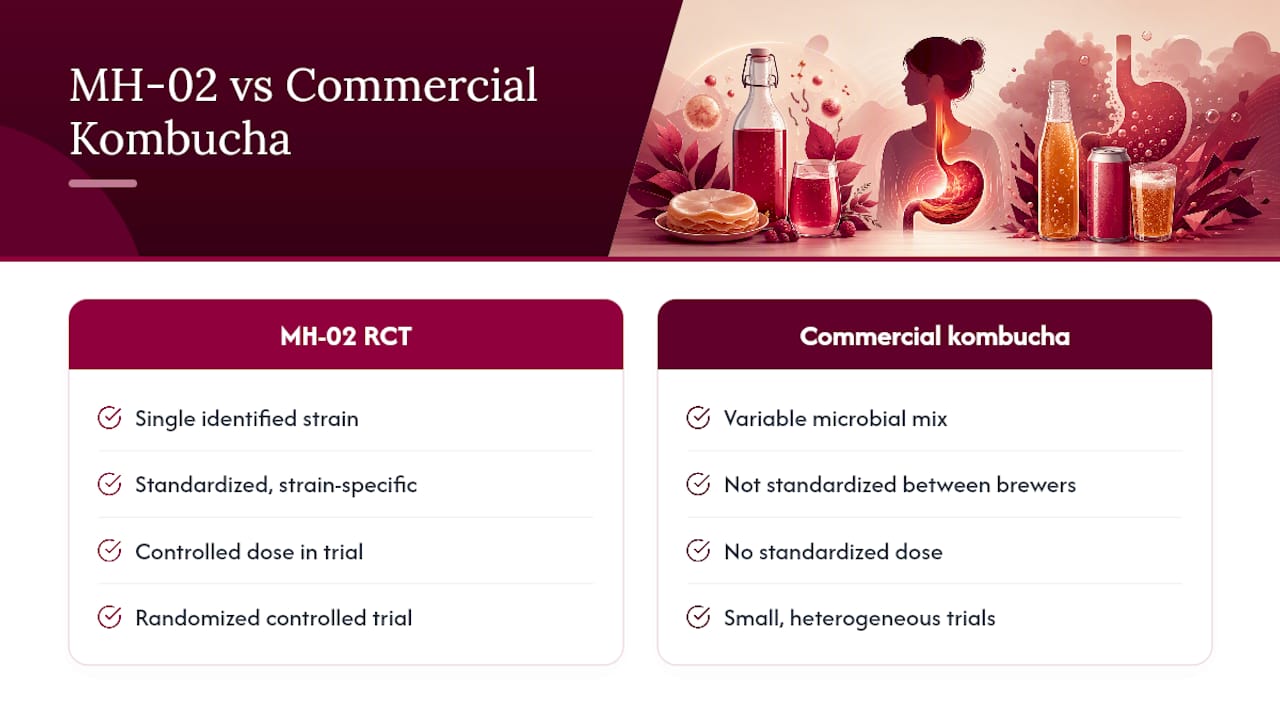
Where the data gets more compelling is with targeted, clinically studied strains rather than kombucha’s variable microbial mix. One randomized controlled trial testing Bifidobacterium animalis subsp. lactis MH-02 as an add-on to standard PPI therapy for reflux esophagitis found greater symptom reduction, with benefits that held up even after the PPI was withdrawn.
That’s a meaningfully different scenario than drinking a bottle of kombucha. Kombucha’s fermentation isn’t standardized. Two bottles from two different brewers can carry entirely different microbial populations, so probiotic benefits documented in clinical trials can’t be assumed to transfer to an unregulated fermented beverage. The limitations across this research are consistent: small sample sizes, short trial durations, heterogeneous strains, and no standardized dose of anything resembling commercial kombucha.
Who Should Avoid Kombucha With Reflux?
Some groups face higher stakes if kombucha turns out to be the wrong call, and for them, self-experimentation isn’t the smart first move.
You should skip kombucha, or check with a doctor first, if you have:
- Active moderate to severe GERD or diagnosed esophagitis
- A recent upper-GI surgery or a history of peptic ulcers
- A pregnancy, given the trace alcohol content and unpasteurized microbial load
- A compromised immune system, since kombucha is a live, unpasteurized ferment
If you’re on a proton pump inhibitor, mention kombucha to your clinician at your next visit. PPIs alter gut microbiome composition, and while some trials pair probiotic strains with PPI therapy with positive results, that pairing was tested with specific clinical strains, not an unstandardized fermented tea.
Professional guidance for GERD commonly recommends cutting carbonated and high-acid drinks entirely as a first-line lifestyle step, which puts kombucha squarely on the list to limit.
Stop and call a doctor if you notice chest pain, unexplained weight loss, difficulty swallowing, or repeated vomiting. None of those are reflux symptoms to manage with diet tweaks.
How to Safely Test Kombucha If You Still Want to Try It
If your reflux is mild and well controlled, and you want to see how your body reacts, do it deliberately instead of guessing.
- Start small. Pour 1 to 4 ounces (roughly 30 to 120 mL), not a full bottle.
- Always pair it with food. Never drink kombucha on an empty stomach, since that’s when acid contact with the esophagus is most direct.
- Pick a gentler bottle. Look for low-acid, short-ferment, lower-sugar options with less caffeine, and favor flatter kombucha over heavily carbonated versions.
- Track your body’s response for 48 to 72 hours. A short symptom diary, noting heartburn, bloating, or regurgitation, tells you more than guessing from memory.
- Know your stop point. If symptoms appear within a day, stop and don’t reintroduce it without medical input.
Pro Tip: Test in the early afternoon with a bland meal, never right before bed. Lying down soon after drinking anything acidic or carbonated gives gravity one less advantage against reflux.
If a small trial goes badly, that’s useful information, not a failure. It just means your gut is telling you to look at gentler options instead.
Gentler Fermented Alternatives Worth Trying
If kombucha doesn’t sit well, you haven’t run out of options. A few alternatives deliver some of the same fermented, gut-friendly appeal with a lower reflux risk profile.
- Water kefir is typically less acidic than kombucha and completely caffeine-free, making it a realistic lower-risk swap for people managing reflux.
- Decaf or rooibos-based fermented teas skip the caffeine entirely and tend to ferment to a milder acidity.
- Targeted probiotic supplements or probiotic yogurt carry the strongest evidence base, since trial data exists for specific, dosed strains rather than a variable home-fermented beverage.
Why Aboocha Leans Toward Caution on Kombucha and Reflux
Customers regularly tell us their digestion feels better after switching to a lower-sugar, gentler-brewed kombucha, and we take that seriously. But anecdote isn’t the same as evidence, and we’d rather say that plainly than oversell what the research supports.
That’s why the recipes are formulated with shorter, gentler fermentation and less residual sugar, aiming for a milder profile without pretending it neutralizes acidity altogether. If you have reflux, we’d still tell you to track your symptoms before you commit to a routine, the same advice we’d give if we didn’t sell a single bottle.
— Luna
Try Aboocha in Small Servings Before You Commit
If you want to test kombucha’s effect on your reflux without over-committing, sampling in small volumes beats buying a case you might not finish. Flavor-forward bottles, including lower-sugar options like Sour Plum and Yuzu Osmanthus, are built for exactly that kind of cautious first taste.
Start with a mixed bundle instead of a subscription, so you can pour a small serving, log how you feel over the next couple of days, and decide from there. If you already know you tolerate gentler ferments well, the Aboocha x Deefruit collaboration set is worth a look for a milder flavor lineup. Order a bundle today and find out how your body responds before you scale up to anything recurring.
This article is general information, not a substitute for advice from a qualified doctor. Consult a qualified healthcare professional about your own circumstances before acting on anything here.
Sources
- Probiotics for Gastrointestinal Conditions: A Summary of the Evidence
- Benefits of Kombucha Consumption: A Systematic Review of Clinical Trials Focused on Microbiota and Metabolic Health
- Therapeutic Evaluation of Bifidobacterium animalis subsp. lactis MH-02 as an Adjunctive Treatment in Patients with Reflux Esophagitis
- Kombucha and acid reflux: Does it make GERD worse?
FAQ
Should I Drink Kombucha If I Have Acid Reflux?
If your reflux is active, it’s best to avoid kombucha or limit it to a very small serving with food. Its acidity and carbonation are both known reflux triggers, so mild cases may tolerate a little, while moderate to severe GERD warrants medical advice first.
What Is the Best Drink for Bad Acid Reflux?
Plain water, herbal teas like chamomile or ginger, and low-fat milk are generally gentler choices than kombucha for people with significant reflux. Carbonated and highly acidic drinks, kombucha included, are commonly flagged in GERD lifestyle guidance as ones to limit.
Who Shouldn’t Drink Kombucha?
People with active moderate to severe GERD, esophagitis, peptic ulcers, recent upper-GI surgery, pregnancy, or a compromised immune system should avoid kombucha or check with a doctor first. Its live, unpasteurized microbial content and trace alcohol raise the risk for these groups specifically.
Which Type of Kombucha Is Best for Acid Reflux?
If you’re going to try kombucha at all, choose a low-acid, short-ferment, lower-sugar variety with reduced carbonation and minimal caffeine. Letting a poured serving sit open for a few minutes before drinking also cuts the fizz without significantly changing its acidity.
Is Kombucha Good for Digestive Health in General?
Kombucha contains live microbes that some small trials link to modest improvements in stool consistency and overall gut symptom scores, though this evidence doesn’t extend clearly to reflux relief. Its microbial makeup varies by batch, so results are inconsistent compared to standardized probiotic strains tested in clinical research.