
Kombucha is safe for most healthy adults when you stick to moderate amounts and buy from a reputable, pasteurized or well-controlled commercial source. The main risks are digestive upset, added sugar, alcohol content that can creep above trace levels, and, in rare cases, contamination or a genuine allergic reaction.
- Gastrointestinal issues: bloating, gas, and diarrhea, especially with large servings
- Sugar and calories: many bottled versions carry more added sugar than you’d expect
- Alcohol: trace to low levels from fermentation, occasionally higher
- Caffeine: variable, since it comes from the tea base
- Dental erosion: acidity can wear enamel over time
- Contamination: rare, but more common in homebrews than commercial bottles
- Liver toxicity or allergic reactions: extremely rare, documented mostly in case reports
A reasonable starting point is a moderate daily serving, working up slowly. If you notice persistent stomach pain, unusual fatigue, or any allergic symptoms, stop drinking it and talk to a doctor.
Key Takeaways
Kombucha is safe in moderation for most healthy adults, but sugar content, trace alcohol, and rare contamination risks make label reading and sourcing decisions genuinely important.
| Point | Details |
|---|---|
| Start small | Try a moderate daily serving and watch for bloating or GI upset before increasing. |
| Check the label | Look for sugar per serving, alcohol percentage, and pasteurized versus raw status. |
| Trace alcohol is real | Commercial testing found average alcohol near 0.26% Vol., with a recorded maximum of 0.48% Vol. |
| Homebrew carries more risk | Most severe adverse reports link to contaminated or poorly managed home batches, not commercial bottles. |
| High-risk groups need extra caution | Pregnant, breastfeeding, immunocompromised, and liver-compromised individuals should consult a clinician first. |
Table of Contents
- What Are the Most Common Kombucha Side Effects?
- Why Does Kombucha Cause Digestive and Other Side Effects?
- Who Should Avoid Kombucha or Use Extra Caution?
- How Do You Consume Kombucha Safely?
- The Safety-First Take on Kombucha
- Sources
- FAQ
What Are the Most Common Kombucha Side Effects?
Before getting into mechanisms and evidence, here’s the full scope of what kombucha can do to your body, from the mundane to the rare.
- Bloating, gas, and diarrhea from the drink’s natural carbonation and acid content, particularly if you drink more than a cup at once
- Added sugar and extra calories, since some commercial brands use sugar to fuel fermentation and then add more for flavor
- Tooth enamel erosion from the combination of acidity and fizz, similar to the concern with soda or citrus juice
- Alcohol content, typically low but not always zero, a detail that matters for anyone avoiding alcohol entirely
- Caffeine effects like jitteriness or sleep disruption, since kombucha starts as black, green, or oolong tea
- Infection or contamination risk, mostly tied to improperly made homebrews rather than store-bought bottles
- Rare but serious reports of liver injury or allergic reactions, almost always linked to unusual circumstances rather than typical consumption
Most of these fall into the “annoying, not dangerous” category. A smaller subset deserves closer attention, which is where the real nuance lives.
Why Does Kombucha Cause Digestive and Other Side Effects?
Gastrointestinal discomfort is the complaint you’ll hear about most, and it comes down to two things: acidity and live carbonation. Kombucha’s organic acids, mainly acetic and lactic acid, have a mild laxative effect and weak antibacterial action, according to a review of kombucha’s health claims and evidence. That review also found that many of the sweeping health claims made about kombucha go beyond what the science actually supports. If you already deal with irritable bowel syndrome or acid reflux, that same acidity can trigger bloating or diarrhea faster than it would for someone with a sturdier gut. Drinking it slowly, with food, tends to blunt the effect.
Sugar and calories matter more than most drinkers assume. Kombucha starts as sweetened tea, and the fermentation process only consumes some of that sugar. Depending on the brand, a bottle can carry varying amounts of sugar, which adds up fast if you’re drinking it daily as a “healthy” replacement for soda. Checking the label matters here as much as checking the ingredient list.
Dental erosion is a quieter risk. Kombucha’s pH sits in acidic territory, and the carbonation adds mechanical wear on top of the chemical exposure. Sipping it through a straw, rinsing your mouth with water afterward, and waiting 30 minutes before brushing (brushing right after acid exposure can scrub away softened enamel) all help.

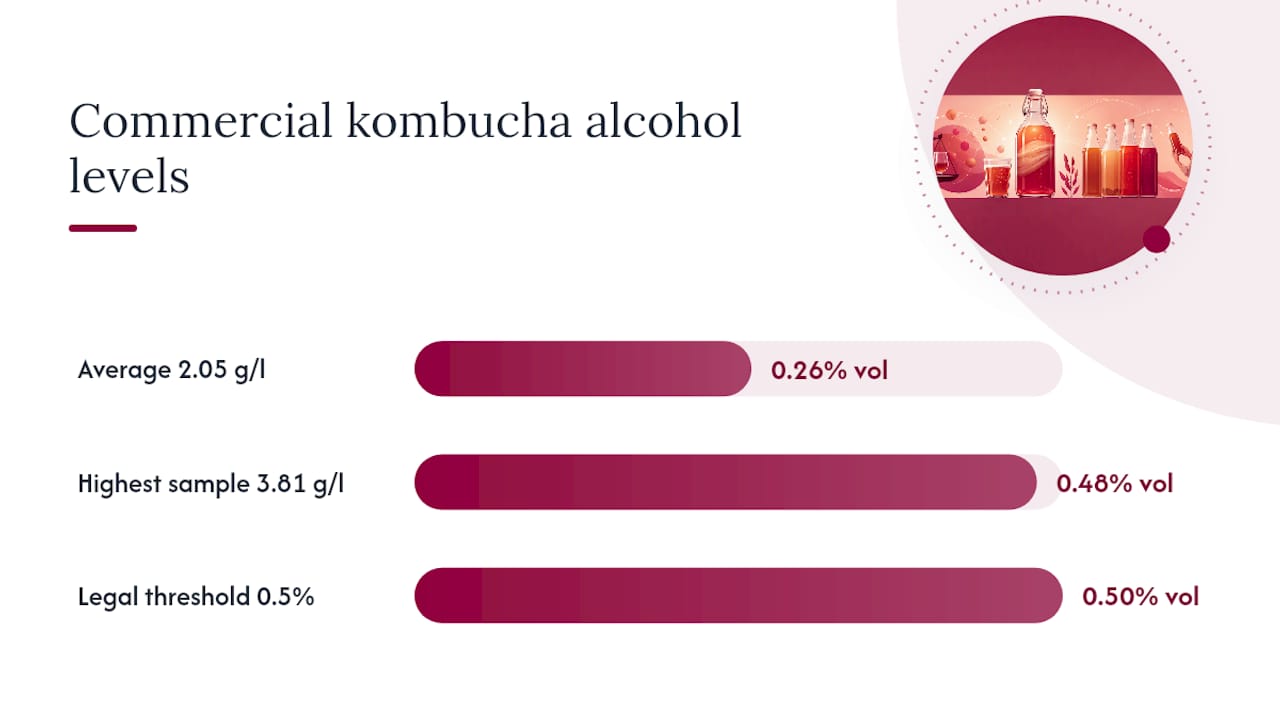
Alcohol content surprises a lot of people who think of kombucha as inherently alcohol-free. Market testing conducted between 2019 and 2025 found commercial samples averaged about 2.05 grams per liter of alcohol, roughly 0.26% by volume, with the highest recorded sample hitting 3.81 g/l, or about 0.48% Vol. None of the tested samples crossed the 0.5% threshold that would legally classify them as alcoholic in most markets, but that’s still not zero, and it’s worth knowing if you’re pregnant, in recovery, or avoiding alcohol for religious or medical reasons.
Caffeine depends entirely on the tea base. A kombucha brewed from black tea will carry more caffeine than one made from green or white tea, and brands rarely disclose exact milligram counts. If you’re caffeine-sensitive, treat an afternoon kombucha the way you’d treat a small cup of tea, not a caffeine-free seltzer.
Those rare adverse event reports are worth taking seriously, but not worth panicking over. Causation in individual case reports is notoriously hard to pin down. A person who drank home-brewed kombucha alongside other supplements, medications, or an existing liver condition makes it difficult to isolate kombucha as the single cause.
Who Should Avoid Kombucha or Use Extra Caution?
Certain groups face a different risk calculation than the average healthy adult, and it’s worth being direct about who they are.
- Pregnant and breastfeeding individuals should treat kombucha with the same caution as any alcohol-containing beverage, even at trace levels, and the contamination risk from unpasteurized products adds a second layer of concern.
- Immunocompromised people, including those on chemotherapy or immunosuppressants, face a higher risk from any live bacteria or yeast that survives in an improperly fermented batch.
- People with compromised liver function or a history of liver disease should be cautious given the rare but documented liver injury case reports tied to kombucha.
- Anyone on diabetes medication should watch blood sugar responses closely, since some formulations carry meaningful added sugar and the fermentation itself can produce unpredictable residual sugar levels.
- Children and teens generally shouldn’t drink kombucha regularly, given the combined caffeine, trace alcohol, and acidity concerns.
If you notice stomach pain that doesn’t resolve within a day, unusual jaundice, hives, or swelling, stop drinking kombucha immediately and contact a clinician rather than waiting it out.
How Do You Consume Kombucha Safely?
The safest approach to kombucha comes down to portion control and paying attention to what’s actually in the bottle.
- Start with a moderate daily serving and see how your body responds before increasing.
- Check the label for sugar per serving, alcohol percentage (or a clear “non-alcoholic” claim), and whether it’s pasteurized or raw/live-cultured.
- Store bottles refrigerated and consume by the printed date. Kombucha shelf life typically runs a few weeks refrigerated, and warning signs it has gone bad include an off, vinegary-sharp smell beyond the normal tang, visible mold (fuzzy spots, not to be confused with the stringy yeast strands that are normal), or a color shift toward brown or gray.
- Favor commercially produced, quality-controlled bottles if you’re in a higher-risk group, since production-scale processes tend to keep alcohol and microbial content more consistent than a kitchen counter batch.
- If you already homebrew, keep close track of fermentation time and temperature, since both push alcohol and acidity higher the longer the batch sits.
Pro Tip: Keep unopened bottles refrigerated even if the label says “shelf stable.” Cold storage slows continued fermentation, which keeps sugar, alcohol, and carbonation levels closer to what’s printed on the label instead of climbing while it sits in your pantry. Brands that formulate with lower sugar content from the start give you one less variable to manage.
Why Is Homemade Kombucha Riskier Than Store-Bought?
Home fermentation removes the quality controls a commercial producer builds in, and that gap is where most severe reports originate. Improvised setups often use metal containers, unwashed hands, or unclear timing, letting mold or harmful bacteria take hold. Extension-service guidance recommends a specific safety checklist:
- Ferment only in glass, never lead-glazed ceramic or reactive metal.
- Sanitize every vessel, utensil, and your hands before handling the culture.
- Discard the entire batch and SCOBY immediately if you see mold or smell anything off. Don’t salvage part of it.
- Track fermentation time and temperature closely, since extended fermentation raises both acidity and alcohol.
Most severe adverse reports trace back to skipped steps like these. If you’d rather skip the fermentation learning curve entirely, commercial bottling removes that variable altogether.
How Do Commercial Brands Manage These Risks?
Reputable producers control fermentation conditions, test batches, and formulate with lower sugar loads specifically to reduce the side effects that concern health-conscious drinkers. Aboocha’s approach, for instance, centers on flavor-forward, lower-sugar recipes rather than the heavily sweetened formulas common in older-style kombucha, aiming to keep the gut-health upside without the sugar spike.
This is illustrative of how one commercial producer approaches risk management, not a claim that every bottle on a shelf meets the same standard. Reading labels still matters regardless of brand.
If you want a bottle that’s already accounted for the sugar and consistency concerns raised throughout this piece, Aboocha’s kombucha lineup is built around exactly that trade-off.
The Safety-First Take on Kombucha
The conventional advice on kombucha tends to swing between two extremes: treating it as a health elixir or dismissing it as fizzy vinegar water with a marketing budget. Neither holds up. The evidence supports a narrower, more useful claim: kombucha offers a mild digestive assist from its organic acids, and the real risks are almost entirely about how it’s made, not the drink itself.
That distinction gets lost constantly. Articles warn about “kombucha risks” as if the beverage carries some inherent danger, when the data points squarely at home fermentation as the actual variable. A commercially produced, lower-sugar bottle from a quality-controlled source and a jar fermenting on someone’s kitchen counter for three weeks are not the same product, even though they share a name.
If you take one thing from this, prioritize sourcing over serving size. Getting the sugar and alcohol content right on the front end matters more than obsessing over whether you drink 4 ounces or 6.
— Luna
This article is general information, not a substitute for advice from a qualified doctor. Consult a qualified healthcare professional about your own circumstances before acting on anything here.
Sources
For deeper reading beyond this guide, the Colorado State University market testing summary on kombucha covers alcohol content data. The PMC review of kombucha benefits and risks examines evidence quality, while PubMed’s indexed adverse event reports document rare severe cases. The Cleveland Clinic’s consumer guide offers practical serving advice.
- Complex food: kombucha (Colorado State University / Food Science & Human Nutrition)
- Review article on kombucha benefits and risks (PMC)
- PubMed indexed reports on adverse events linked to kombucha
FAQ
Is It Safe to Drink Kombucha Every Day?
For most healthy adults, a moderate daily serving is generally considered safe, though you should watch for digestive symptoms and check sugar and alcohol content on the label.
What Does Kombucha Do to Your Body?
Kombucha’s organic acids provide a mild laxative effect and weak antibacterial action, but most other health claims lack strong supporting evidence.
What Should You Not Mix With Kombucha?
Avoid pairing kombucha with alcohol, since its trace alcohol content adds up, and be cautious combining it with other fermented or probiotic supplements if you’re prone to bloating, since the combined acid and bacterial load can intensify GI symptoms.
What Are the Potential Side Effects of Fermented Tea Drinks Like Kombucha?
The most common effects are bloating, gas, and diarrhea, along with added sugar intake and trace alcohol exposure; rare cases involve liver injury or allergic reactions, almost always tied to contaminated homebrews.