
That tart, vinegary bite in every sip of kombucha is not an accident or just a flavor choice. It comes from organic acids, which are the real bioactive workhorses behind kombucha’s reputation as a gut-friendly drink. Understanding what are organic acids in kombucha means looking beyond taste to see how these compounds shape digestion, preservation, and your body’s detox pathways. This article breaks down the specific acids produced during fermentation, what each one does, and how to choose a kombucha that actually delivers on its health promises.
Table of Contents
- Key Takeaways
- What are organic acids in kombucha, explained
- How these acids support digestion and detox
- Why organic acid profiles vary across products
- The minor acids and their underrated roles
- My take on reading kombucha the right way
- Discover Aboocha’s fermented difference
- FAQ
Key Takeaways
| Point | Details |
|---|---|
| Acids drive fermentation outcomes | Acetic, gluconic, and glucuronic acids are the primary fermentation metabolites that lower pH and create kombucha’s functional properties. |
| Glucuronic acid supports detox | This acid binds toxins in the liver and assists the body’s natural elimination pathways. |
| Acid profiles vary by batch | Fermentation time, tea type, and SCOBY strains all shift the organic acid composition between products and homebrews. |
| Tanginess does not equal health | A very sour kombucha is not automatically more beneficial. Health effects come from the full metabolite mix, not acid concentration alone. |
| Minor acids still contribute | Succinic, malic, and citric acids appear in small amounts but add flavor complexity and mild preservation effects. |
What are organic acids in kombucha, explained
The phrase “organic acids” refers to carbon-based compounds with acidic properties. In chemistry, they belong to a class called carboxylic acids, recognized by their characteristic carboxyl group. In kombucha, they are not added ingredients. They are produced by living microorganisms during fermentation.
The SCOBY (symbiotic culture of bacteria and yeast) drives all of it. Yeasts in the SCOBY consume sugar and produce ethanol as a byproduct. Then acetic acid bacteria take that ethanol and oxidize it aerobically into acetic acid. Separately, bacteria like Komagataeibacter species oxidize glucose directly into gluconic and glucuronic acids through distinct enzymatic pathways. The result is a finished beverage containing multiple organic acids that collectively lower pH, stabilize the drink, and create its layered sour flavor.
The three most prominent acids by concentration are acetic acid, gluconic acid, and glucuronic acid. But the kombucha ingredients list does not stop there. Depending on fermentation conditions, you will also find succinic, citric, malic, tartaric, and quinic acids in lower amounts. Each plays a role.
Pro Tip: If you are new to reading kombucha labels, “naturally fermented” or “raw” on the packaging is a better indicator of live organic acid content than any generic probiotic claim.
Here is a breakdown of the major acid formation process:
- Acetic acid: Produced when acetic acid bacteria oxidize yeast-derived ethanol. This is the same acid found in vinegar and it tends to be the most abundant in finished kombucha.
- Gluconic acid: Formed through direct bacterial oxidation of glucose. Contributes a milder, softer sourness compared to acetic acid.
- Glucuronic acid: Also derived from glucose oxidation by Komagataeibacter spp. This one gets the most attention for its role in liver detoxification.
- Minor acids: Succinic, citric, malic, and others appear at under 1 g/L but round out the sensory and functional profile.
Fermentation conditions matter enormously here. Longer fermentation generally increases acetic acid concentration, pushing the pH lower and making the drink more vinegary. Temperature, oxygen exposure, and SCOBY maturity all shift the acid balance across different batches. This is why two bottles from different brands can taste and function quite differently even if both call themselves kombucha.
How these acids support digestion and detox

The kombucha health benefits most people associate with this drink trace directly back to its organic acid content. But the mechanism behind each acid is specific enough that it is worth understanding individually.
Acetic acid is probably the most studied. It supports gut enzyme activity and plays a role in slowing carbohydrate absorption after meals, which helps moderate blood glucose spikes. If you have ever noticed that drinking kombucha with a meal seems to reduce post-meal sluggishness, that is acetic acid doing part of the work.
Glucuronic acid gets a lot of attention in detoxification research. The liver uses a process called glucuronidation to bind toxins, metabolic waste products, and steroid hormones so they can be safely excreted. Glucuronic acid facilitates this process by acting as a conjugation agent. While more human clinical studies are needed to quantify the exact effect from dietary intake, the biochemical pathway is well established.
Gluconic acid contributes both sensory and functional properties. Its softer acidity balances the sharpness of acetic acid, making the drink more palatable. It also shows mild prebiotic properties, potentially supporting beneficial bacteria in the gut.
Kombucha’s digestive benefits come from a coordinated system, not a single compound. Organic acids act alongside polyphenols from tea, B vitamins, and live microorganisms to create the full functional effect. Isolating one acid and crediting it with all the benefits misses the bigger picture.
The synergy with polyphenols is especially worth noting. Tea-derived catechins and other polyphenols already carry their own anti-inflammatory and antioxidant properties. When they combine with the acidic environment created by organic acids, their bioavailability may actually improve. Some research suggests the lower pH enhances polyphenol stability during digestion.
Here are the key health-related effects tied to the major acids:
- Acetic acid: Supports gut enzyme function, moderates blood glucose response after eating
- Glucuronic acid: Assists liver detox pathways by binding waste compounds for excretion
- Gluconic acid: Mild prebiotic effect, contributes to palatability and mineral absorption
- Combined effect: Creates an acidic gut environment less hospitable to harmful bacteria
One important caveat. Kombucha’s tanginess and health effects do not scale together linearly. A batch that tastes extremely sour has not necessarily concentrated all its benefits. The health outcomes depend on which acids are present, at what concentrations, and how they interact with the rest of the beverage’s metabolite profile. Paying attention to fermented foods and bloating science gives you a clearer picture of how fermentation outputs affect digestive health overall.
Why organic acid profiles vary across products
Not all kombuchas are created equal. The organic acid content in any given bottle depends on a set of interacting variables that can shift significantly from brand to brand and even batch to batch.
Product variability is one of the most under-discussed topics in the functional beverage space. Labels rarely disclose actual acid concentrations. Probiotic claims can be misleading since organic acid concentration and pH vary greatly batch-to-batch due to fermentation variability. Here is what actually drives those differences:
| Factor | Effect on organic acids |
|---|---|
| Fermentation time | Longer fermentation raises acetic acid, lowers pH further |
| Tea type | Green tea base produces a milder acid profile; black tea yields stronger acidification |
| SCOBY microbial strains | Different bacterial populations favor different acid pathways |
| Oxygen exposure | More oxygen during fermentation accelerates acetic acid bacteria activity |
| Temperature | Higher temps speed fermentation and can intensify acid production |
| Sugar concentration | More sugar provides more substrate for acid-producing microbes |
For consumers, this means a bottle labeled “raw kombucha” at a grocery store may have a very different acid profile than one brewed locally with a well-maintained SCOBY. Fermentation progression and acid accumulation are tightly linked, and commercially produced kombucha often halts fermentation early to control tartness and carbonation.
If you brew at home, fermentation time is your most direct control lever. Tasting daily after day five gives you a real-time read on where the acid balance sits. Stopping earlier keeps gluconic acid higher relative to acetic acid, producing a softer, more approachable sourness. Letting it run longer pushes the acetic acid concentration up, creating a more vinegary, preservation-focused result.
Pro Tip: When choosing a commercial kombucha, look for one that discloses pH or is marketed as less sweet. Lower residual sugar usually correlates with more complete fermentation and a fuller organic acid profile.
Understanding how kombucha is fermented gives you the context to interpret these product differences instead of just guessing from the taste.
The minor acids and their underrated roles
Less discussed but genuinely present, the minor organic acids in kombucha add real value even at concentrations under 1 g/L. Minor acids like succinic, citric, malic, and tartaric acids contribute to the overall sensory and functional character of the drink in ways that complement the major trio.
| Acid | Origin in kombucha | Primary contribution |
|---|---|---|
| Succinic acid | Yeast fermentation byproduct | Umami-like depth in flavor, mild antimicrobial effect |
| Citric acid | Bacterial metabolism | Brightness in taste, preservative quality |
| Malic acid | Found naturally in tea, enhanced by fermentation | Smooth tartness, supports energy metabolism pathways |
| Tartaric acid | Tea origin and microbial activity | Texture and body in the beverage |
| Quinic acid | Derived from chlorogenic acid breakdown | Astringency, antioxidant activity |
What makes these acids interesting is not their concentration but their interactions. Citric acid, for instance, chelates metal ions, which means it can improve mineral absorption from other foods consumed at the same meal. Malic acid participates in the citric acid cycle in human cells, meaning it has a minor role in cellular energy production. Quinic acid, formed from the breakdown of tea’s chlorogenic acids, carries its own antioxidant activity independent of tea polyphenols.
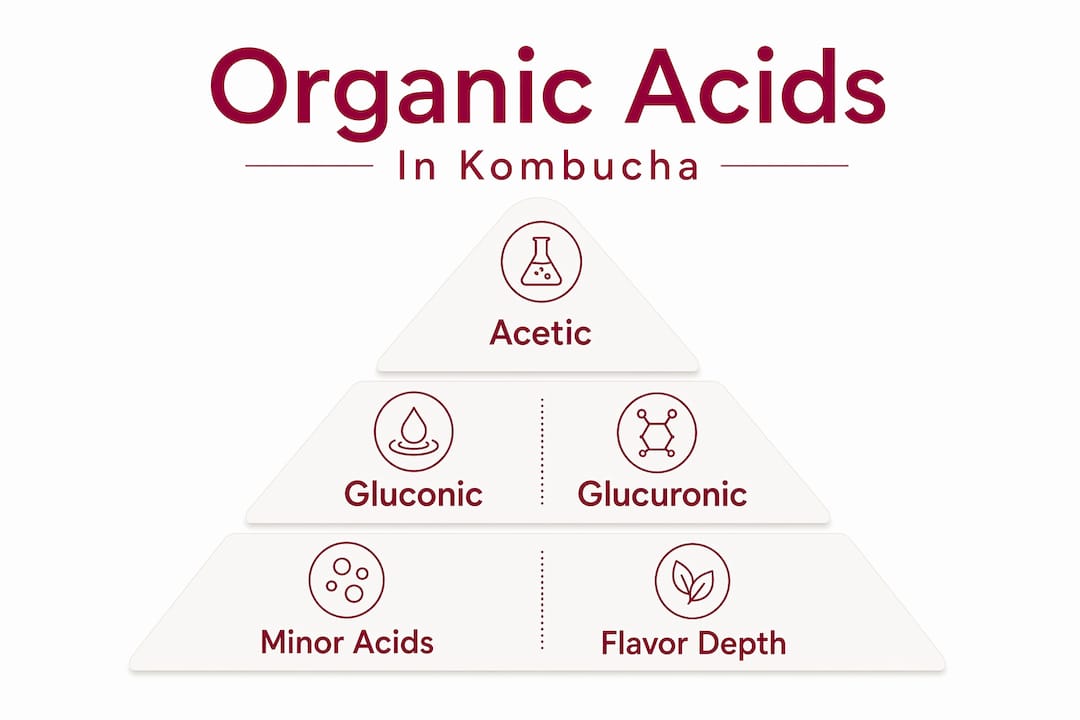
Taken together, these minor acids act as a supporting cast that gives a well-fermented kombucha its depth of flavor and a broader functional range than any single acid could provide alone.
My take on reading kombucha the right way
I have spent years looking at fermented beverages through a health lens, and the most common mistake I see is people treating kombucha sourness as a simple health meter. The logic goes: more tart equals more benefits. That instinct is understandable but it misses the point.
In my experience, the most functionally rich kombuchas are not necessarily the most aggressive on your palate. A well-balanced brew where gluconic acid keeps some softness while acetic acid does the preservation work often reflects better fermentation practice than something that tastes like straight vinegar. The organic acid spectrum matters more than intensity.
What I find genuinely useful is paying attention to how you feel after drinking a particular kombucha consistently for a few weeks. Digestion response, post-meal comfort, and energy are real signals. They are not perfect data, but they tell you more than a sip test ever will.
The other thing worth saying plainly: most kombucha labels are not giving you the information you need to evaluate acid content. Until that changes, sourcing from producers who are transparent about their fermentation process is the most reliable filter you have. Brands that discuss SCOBY health, fermentation duration, and pH management are telling you something meaningful. Brands that just say “loaded with probiotics” are not.
— Luna
Discover Aboocha’s fermented difference
If reading about organic acids has made you think more carefully about what is actually in your kombucha, Aboocha is worth exploring. Aboocha crafts flavor-forward kombucha with lower sugar content and consistently maintained fermentation standards, which means the organic acid profiles you read about here translate into what ends up in the bottle. Flavors like Sour Plum and Yuzu Osmanthus are not just interesting taste choices. They reflect a commitment to complex, well-fermented beverages that genuinely support digestive wellness. Browse Aboocha’s kombucha range and find a subscription plan that fits your routine.
FAQ
What are the main organic acids found in kombucha?
Acetic acid, gluconic acid, and glucuronic acid are the three most concentrated organic acids in kombucha. Smaller amounts of succinic, citric, malic, tartaric, and quinic acids are also present and contribute to flavor and function.
Does more tartness mean more health benefits?
Not directly. A very sour kombucha has higher acetic acid concentration, but health outcomes depend on the full metabolite mix including polyphenols, enzymes, and multiple acids working together. Tanginess alone does not map one-to-one to health efficacy.
How does fermentation time affect organic acid content?
Longer fermentation raises acetic acid levels and lowers pH further. Shorter fermentation preserves more gluconic acid relative to acetic acid, producing a milder flavor and a different functional profile.
What does glucuronic acid do in the body?
Glucuronic acid supports liver detoxification by binding toxins, metabolic waste products, and steroid hormones so the body can excrete them. This is why it gets particular attention in discussions about kombucha’s detox-related benefits.
Why do different kombucha brands taste so different?
Differences in SCOBY strains, tea type, fermentation time, temperature, and oxygen exposure all shift the organic acid balance significantly. These variables explain why two bottles labeled “kombucha” can taste and function quite differently from each other.