
Kombucha is not a treatment for gastritis, and during an active flare it’s one of the drinks worth skipping. Its acidity (pH around 2.5 to 3.5) and carbonation can aggravate an already irritated stomach lining. Once symptoms settle, a small, plain trial may be reasonable for some people, but anyone with severe, recurring, or worsening pain should talk to a doctor before adding it back.
TL;DR:
- Kombucha’s acidity and carbonation can worsen symptoms during a gastritis flare and should be avoided until inflammation subsides.
- Short-term studies show limited and inconsistent benefits, with no evidence that kombucha heals or calms inflamed stomach lining in humans.
- Variability in fermentation, sugar content, and ingredients makes general recommendations difficult, so choosing lower-sugar, controlled products may improve tolerance.
- People with active gastritis, pregnant individuals, immunocompromised persons, and those with liver issues should consult a doctor before trying kombucha.
- Once symptoms have resolved, a small, cautious trial—starting with 50-100 milliliters after a meal—can be considered, but any return of symptoms warrants stopping.
Table of Contents
- Does Kombucha Help Gastritis? What the Research Shows
- How Kombucha Might Help or Hurt Your Stomach
- Who Should Avoid Kombucha During a Gastritis Flare
- How to Trial Kombucha Safely Once Symptoms Settle
- Better Alternatives While Your Stomach Heals
- Where Aboocha Fits Into This Guidance
- A Straight Answer, Not a Sales Pitch
- Try Aboocha’s Lower-Sugar Kombucha, on Your Own Terms
- Sources
- FAQ
Does Kombucha Help Gastritis? What the Research Shows
Human evidence on kombucha and gut health is thinner than the marketing suggests. A 2025 systematic review of clinical trials pooled the available human studies and found effects that were modest at best and inconsistent across trials. Some studies picked up improvements in stool consistency and reduced feelings of incomplete evacuation. Others found little change in inflammatory markers or gut microbiota diversity. None of them showed kombucha healing or calming an inflamed stomach lining, which is the actual definition of gastritis.
A few things about these trials matter more than the headline results:
- Most ran for only 10 days to 10 weeks, too short to say anything about long-term effects.
- Sample sizes were small, often a few dozen participants.
- Formulations varied wildly. One trial’s kombucha might barely resemble another’s in sugar content, fermentation time, or bacterial strain mix.
That heterogeneity is exactly why the review’s authors stopped short of recommending kombucha as a therapeutic option for digestive conditions. Separate PubMed-indexed research on gut microbiota shifts after kombucha intake reports similar noise: some symptomatic improvement in a subset of people, no consistent metabolic signal across the group.
There’s also a 2010 animal study worth mentioning, mostly to explain why it doesn’t settle the question. Researchers found dose-dependent ulcer-healing effects in mice given kombucha over seven days. That’s an interesting preclinical signal, but mouse stomachs and human stomachs don’t respond identically to fermented beverages, and no human trial has replicated the finding. One registered pilot study currently underway (Clinicaltrials) is testing two daily 16-ounce servings of commercial kombucha against microbiome and inflammation markers. It excludes anyone with active gastrointestinal disease from enrolling. That exclusion criterion is a quiet but telling detail: even researchers designing a study to find benefits don’t consider it safe to test on people currently flaring.
How Kombucha Might Help or Hurt Your Stomach
Kombucha is fermented tea loaded with live bacteria, yeast strains, and metabolic byproducts, including organic acids like acetic, gluconic, and lactic acid, plus polyphenols carried over from the tea leaves. Those compounds are doing double duty, some potentially helpful, some potentially irritating, depending on your stomach’s current state.
The organic acids appear to be the main driver behind the stool-related benefits seen in some trials. Increased motility and softer stool line up with what these acids do elsewhere in the gut. That’s a plausible mechanism for constipation relief, not for gastritis.
Here’s the problem for anyone with an inflamed stomach lining: the same acidity that may support motility further down the digestive tract can directly irritate tissue that’s already inflamed higher up. Add carbonation, and you get gas that stretches the stomach and can worsen pressure-related pain. This combination is why kombucha shows up on lists of foods to approach carefully for reflux and gastritis, despite its reputation as a gut-health drink.
Product variability makes generalizing even harder. Fermentation time changes acidity. Tea base (black, green, or a blend) changes polyphenol content. Sugar levels affect both flavor and how much fermentation activity is still happening in the bottle. Trace alcohol content, a natural fermentation byproduct, varies by batch and brand.
Pro Tip: If you’re curious about mechanism over marketing, check whether a brand lists fermentation time or batch testing on its site. Vague labeling usually means more product variability, not less.
Who Should Avoid Kombucha During a Gastritis Flare
Active gastritis is where kombucha poses the most real risk, and the reasons are specific, not just cautionary boilerplate.
- Acid and carbonation together provoke symptoms directly. Gleneagles Hospital’s dietary guidance for gastritis explicitly lists acidic foods and carbonated beverages as items to avoid, and groups probiotic drinks like kombucha among foods that warrant caution.
- Trace alcohol and caffeine can compound irritation. Kombucha’s fermentation naturally produces small amounts of alcohol, typically under 0.5%, but even that trace amount can interact poorly with an already inflamed stomach lining or with certain medications.
- Pregnant people, immunocompromised individuals, and those with severe liver disease face added risk. Live cultures and unpasteurized ferments carry a small but real contamination risk, one that matters more when your immune system or liver function is already compromised.
- Homebrewed kombucha raises contamination odds further. Without commercial quality controls, home batches can harbor unwanted bacterial or mold growth that a controlled brewing process would catch.
Watch for red flags that mean it’s time to stop experimenting and get medical attention: vomiting blood or material that looks like coffee grounds, black or tarry stools, severe abdominal pain that doesn’t ease, or unexplained weight loss. None of these are “wait and see” symptoms. Kombucha, or any other dietary trial, takes a back seat to a clinical evaluation at that point.
How to Trial Kombucha Safely Once Symptoms Settle
If your gastritis symptoms have resolved and you want to reintroduce kombucha, treat it like any other reintroduction after a digestive flare: small, slow, and observed closely.
- Start with just 50 to 100 milliliters, taken after a meal rather than on an empty stomach.
- Give it 24 to 48 hours before drawing any conclusion, since delayed reactions are common with fermented foods.
- Choose commercial products over homebrew while you’re testing tolerance. Commercial batches undergo more consistent quality control.
- Favor lower-sugar, lower-carbonation options. Reading the label for ABV, sugar per serving, and added ingredients tells you more about how a bottle will sit with you than the brand story on the front.
- Skip flavors with chili, ginger, or other stomach-stimulating additions until you know your baseline tolerance.
If symptoms come back, even mildly, stop and don’t push through it. That’s not a failed experiment, it’s useful information about where your gut currently stands.
Pro Tip: Keep a simple log: date, amount, timing relative to food, and how you felt over the next two days. Patterns show up faster than memory does.
Better Alternatives While Your Stomach Heals
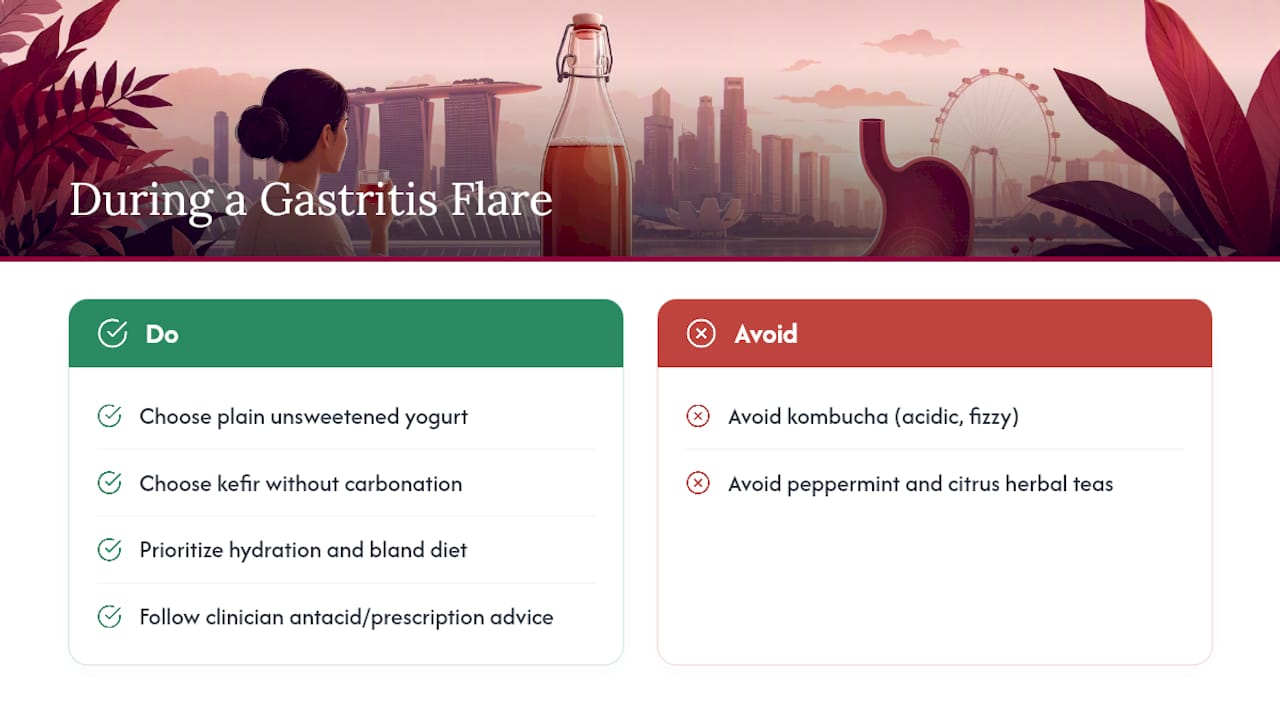
Kombucha isn’t the only fermented option, and during a flare it’s usually not the gentlest one. Plain, unsweetened yogurt and specific kefir varieties without added carbonation deliver probiotic content without the acidity and fizz that make kombucha risky for an inflamed stomach.
Beyond fermented options, basic hydration and a bland diet still do most of the heavy lifting during a flare. Clinicians may recommend antacids or prescribed therapy depending on the underlying cause, particularly if H. pylori infection or NSAID use is involved.
One caution worth flagging: not every “gentle” herbal tea is actually gentle. Peppermint and certain citrus-based blends can relax the lower esophageal sphincter and worsen reflux in some people, so gentler doesn’t mean automatically safe. If diarrhea rather than reflux is your main issue, there are gentler fermented options worth exploring before ruling out fermented drinks entirely. For a broader look at how fermentation and gut bacteria interact more generally, this explainer on the gut microbiome is a useful primer.
Where Aboocha Fits Into This Guidance
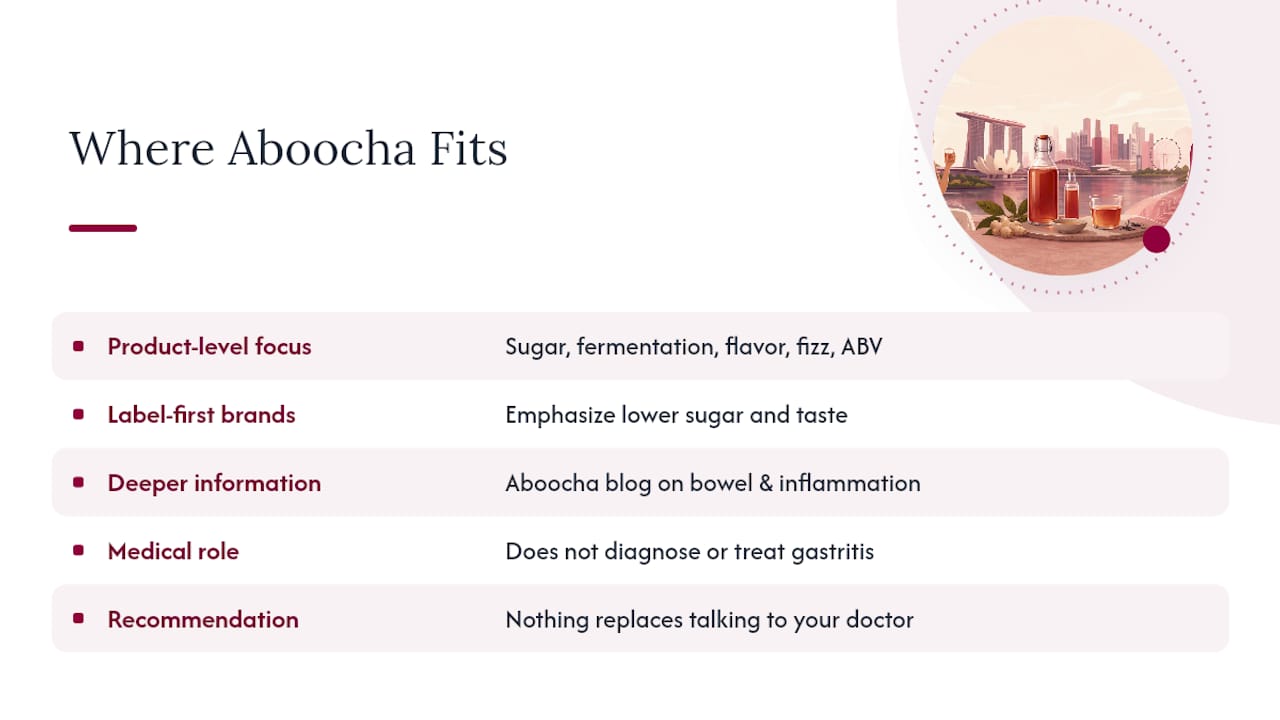
Some kombucha brands use label-first thinking by focusing on lower sugar content, controlled fermentation, and flavor profiles built around taste rather than aggressive carbonation. That doesn’t make kombucha a gastritis treatment. It means the product-level factors that matter for tolerance, sugar, fizz level, and ABV, can be designed around rather than left to chance.
For readers who want to go deeper on the science before making their own call, Aboocha’s own blog covers kombucha’s effect on bowel regularity and inflammation research in more detail. Aboocha sells kombucha and shares what the research says about it. It doesn’t diagnose or treat gastritis, and nothing here replaces a conversation with your doctor.
A Straight Answer, Not a Sales Pitch
The honest read on kombucha and gastritis is that the enthusiasm outpaces the evidence. Stool-consistency improvements and mild microbiome shifts in short trials are real findings, but they’re not the same as proof that kombucha soothes an inflamed stomach. During a flare, the acidity and carbonation work against you more than any probiotic content works for you.
Once you’re symptom-free, a cautious, small trial is reasonable for most people. If your gastritis is severe, recurring, or tied to something like H. pylori, get that addressed clinically first. Kombucha is a nice-to-try, not a nice-to-need.
— Luna
Try Aboocha’s Lower-Sugar Kombucha, on Your Own Terms
Aboocha exists because most kombucha on the shelf wasn’t built with sensitive stomachs in mind. Every flavor, from Sour Plum to Yuzu Osmanthus, is formulated with lower sugar and consistent, controlled fermentation, the exact factors this guide recommends checking before you trial any kombucha.
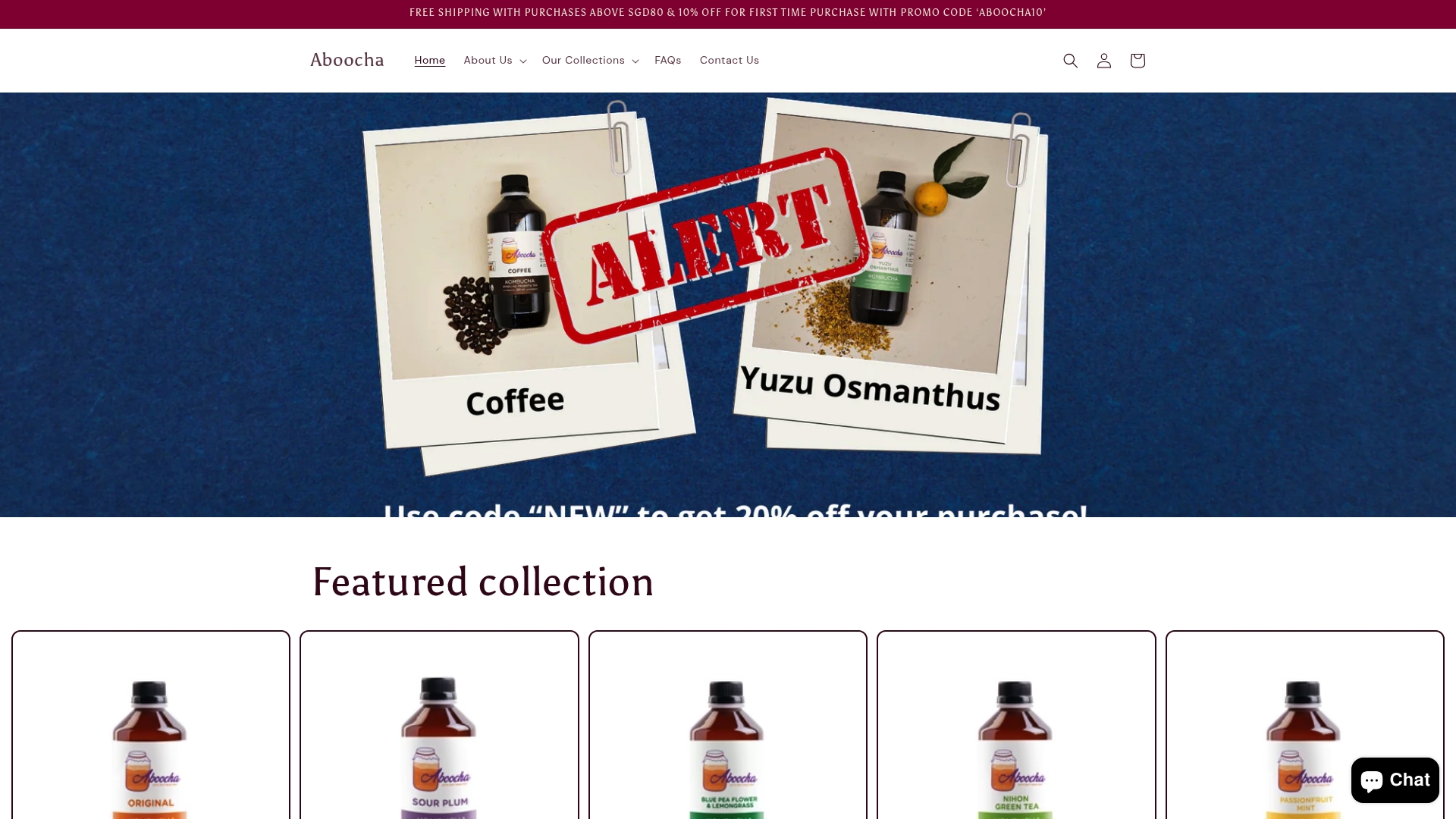
If you’re ready to test tolerance carefully rather than guess your way through a supermarket aisle, start with a curated option like the Aboocha x Deefruit Collaboration set, or browse bundles built for trying smaller servings across flavors. Offices looking to keep a consistent, quality-controlled option on hand can also look at corporate pantry and subscription orders. Whatever you choose, treat it as a personal experiment, not a prescription, and check in with your doctor if gastritis symptoms are active or severe.
This article is general information, not a substitute for advice from a qualified doctor. Consult a qualified healthcare professional about your own circumstances before acting on anything here.
Sources
- Systematic review (2025) on kombucha clinical trials
- Gastritis - Frequently Asked Questions (FAQs) | Gleneagles Hospital
- 2010 preclinical kombucha ulcer-healing study
- Clinicaltrials
FAQ
What drink calms gastritis best?
Plain water, oral rehydration solutions, and non-carbonated, unsweetened beverages are generally gentler choices during a flare than fermented or acidic drinks like kombucha.
Will kombucha help with stomach acid?
There’s no clinical evidence that kombucha reduces stomach acid or improves gastritis. Its own acidity and carbonation are more likely to aggravate an inflamed stomach lining than calm it.
Is kombucha good for gastric issues?
It depends on the issue and the timing. Small trials suggest mild benefits for constipation-related symptoms, but no trial supports it for active gastric inflammation, and hospital dietary guidance recommends avoiding it during flares.
Who should avoid drinking kombucha?
Anyone with active gastritis, pregnant people, immunocompromised individuals, and those with severe liver disease should avoid kombucha or check with a doctor first, given its trace alcohol content and live culture load.
Can Aboocha’s kombucha be part of a gastritis-friendly diet?
Aboocha’s lower-sugar, controlled-fermentation approach aligns with the product factors worth checking before any trial, but it’s not a treatment, and anyone with active gastritis should wait until symptoms resolve before testing tolerance.