
If you want a quick rule of thumb: look for kombucha with 1–3 g of sugar per 100 mL on the Nutrition Information Panel, and check that the label lists “added sugar” separately. A 250 mL serving in that range delivers roughly 2.5–7.5 g of free sugars, leaving you well inside Switzerland’s 50 g/day guideline from the Federal Food Safety and Veterinary Office (FSVO).
Quick picks worth knowing:
- Dry-fermented kombucha — extended fermentation consumes most starting sugar; residual levels often fall below 2 g per 100 mL
- Pasteurized low-sugar kombucha — heat-stabilized after fermentation; check the NIP since sugar varies widely by brand
- Fiber-enhanced kombucha — combines prebiotic fiber with live cultures; tends to carry lower net sugar and added gut-health value
One serving of a low-sugar kombucha in a 330 mL bottle typically delivers 5–10 g of free sugars, well within Switzerland’s 50 g/day ceiling. That leaves plenty of room for the rest of your meals.
Table of Contents
- What does “low sugar” actually mean in Switzerland?
- How do you read a kombucha sugar label correctly?
- What does research say about kombucha and digestion?
- How to choose a genuinely low-sugar kombucha in Switzerland
- Where can you buy low-sugar kombucha in Switzerland?
- What are the safety and serving guidelines for kombucha?
- Key Takeaways
- A note on what the label math actually changes
- Aboocha: low-sugar kombucha with a subscription that actually works
- Useful sources and further reading
- FAQ
What does “low sugar” actually mean in Switzerland?
Switzerland’s federal nutrition guidelines cap free sugar intake at 10% of daily energy, which works out to about 50 g per day for a sedentary adult eating 2,000 kcal. The FSVO specifically flags beverages as a major delivery vehicle for those sugars, and Swiss policy leans on voluntary industry reformulation rather than mandatory taxes to bring numbers down.
50 g/day is the Swiss free-sugar ceiling. A single 250 mL serving of kombucha at 3 g/100 mL contributes 7.5 g — 15% of that budget in one glass.
A national nutrition survey found that beverages account for 29% of free sugar intake in Switzerland, with soft drinks and sugar-sweetened beverages hitting 20% among younger adults. That context matters when you are choosing between a standard soda and a low-sugar fermented drink.
Practical targets for a kombucha serving:
- Under 3 g per 100 mL — genuinely low sugar; fits easily into a balanced day
- 3–5 g per 100 mL — moderate; fine occasionally, but watch portion size
- Above 5 g per 100 mL — closer to a soft drink; read the label carefully before making it a daily habit
How do you read a kombucha sugar label correctly?
The number that matters most is added sugar, not total sugar. Kombucha naturally contains trace sugars from fermentation byproducts, so total sugar can look higher than what the SCOBY actually left behind. Always find the “added sugar” line on the Nutrition Information Panel.
The math is straightforward. If a label reads 2.5 g per 100 mL and your bottle is 330 mL, multiply: 2.5 × 3.3 = 8.25 g per bottle. Cleveland Clinic dietitians note that 4 g of added sugar equals 1 teaspoon of table sugar, so 8.25 g is just over two teaspoons — a useful mental anchor.
Hidden sugar sources to watch on ingredient lists:
- Fruit juice concentrates (often listed after water and tea)
- Honey, agave syrup, or coconut sugar (still free sugars)
- Flavored syrups added post-fermentation
- Sugar alcohols like sorbitol or maltitol (lower glycemic, but can cause GI distress in quantity)
- Artificial sweeteners like aspartame (calorie-free but carries its own cautions)
Pro Tip: Front-of-pack claims like “naturally low sugar” or “no added sugar” are marketing, not regulation. Flip the bottle and read the NIP every time — the added sugar line is the only number that counts.
What does research say about kombucha and digestion?
The honest answer: promising, but not proven at scale. A systematic review of clinical trials found that kombucha consumption was associated with reduced intensity of constipation-related complaints and modest shifts in gut microbiota composition. Those are real signals, not noise, but the trials varied enough in dose, duration, and design that no single definitive number emerges.
Fermentation produces organic acids including acetic, glucuronic, and malic acids, along with phenolic compounds linked to antioxidant activity. These are the plausible mechanisms behind the digestive effects. A separate RCT on fiber-enriched kombucha found increased Bifidobacterium abundance and reduced serum triglycerides, suggesting that combining prebiotic fiber with fermented tea amplifies the gut benefit beyond either alone.
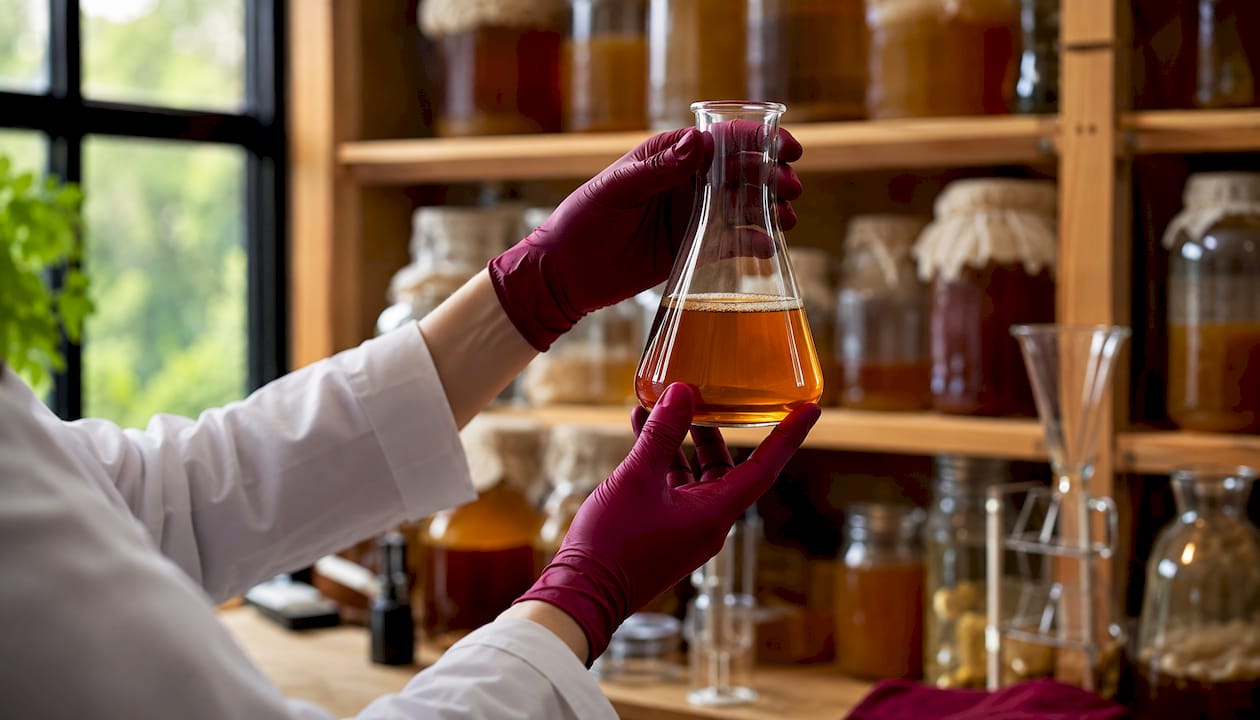
What is plausible: regular, moderate consumption supporting bowel regularity and a more diverse microbiome. What needs more research: therapeutic dosing, long-term effects, and whether benefits hold across different populations.
How to choose a genuinely low-sugar kombucha in Switzerland
Follow this checklist before you buy:
- Check the NIP first — find added sugar per 100 mL; target under 3 g
- Calculate your serving — multiply per-100 mL figure by your bottle size in units of 100 mL
- Scan the ingredient list — reject any product listing fruit juice concentrate or flavored syrup in the first five ingredients
- Decide: raw vs. pasteurized — raw retains live cultures but has a shorter shelf life; pasteurized is shelf-stable but may have fewer active cultures
- Consider fiber-enhanced options — the RCT evidence for synbiotic benefit is stronger here
| Type | Sugar (g/100 mL) | Typical serving | Organic acid markers |
|---|---|---|---|
| Dry-fermented | under 2 g | 250–330 mL | High acetic, glucuronic |
| Pasteurized low-sugar | 1–3 g | 250–330 mL | Moderate acetic |
| Fiber-enhanced | 1–3 g | 200–250 mL | Acetic + prebiotic fiber |
One trial reported a product with ~1.7 g of sugars in a 330 mL serving — that is the realistic floor for commercially available low-sugar kombucha.
Pro Tip: If a front-of-pack label says “gut health” or “probiotic,” that claim is unregulated in Switzerland. The Nutrition Information Panel is the only legally required disclosure — trust that, not the marketing copy.
Where can you buy low-sugar kombucha in Switzerland?
Switzerland’s approach to sugar reduction relies on voluntary reformulation, so product availability genuinely varies by retailer. Your best channels:
- Specialty health-food stores (Bio-Läden, Reformhäuser) — typically stock a wider range of raw and low-sugar fermented drinks than mainstream supermarkets
- Organic grocery chains — look for refrigerated kombucha sections; check labels since sugar content varies even within the same brand’s lineup
- Farmers’ markets — local producers often ferment longer, which means lower residual sugar; ask directly about their sugar content per 100 mL
- Online direct-to-consumer — lets you filter by sugar content before buying; many brands publish full NIPs on their product pages
- Subscription services — the most reliable way to maintain a consistent low-sugar supply without re-checking labels every week
For Swiss readers who want a tested low-sugar option delivered consistently, Aboocha’s subscription bundles are worth a look. The brand publishes sugar content transparently and offers flavors like Sour Plum and Yuzu Osmanthus that make sticking to a low-sugar routine genuinely enjoyable rather than a compromise.
What are the safety and serving guidelines for kombucha?
Clinical trials administered kombucha in doses ranging from 200 mL to 473 mL per day, which is the most evidence-backed range. Starting at the lower end — around 200 mL daily — makes sense if your gut is not used to fermented foods.
Possible adverse effects from excessive intake:
- Bloating or GI discomfort, especially when starting out
- Headache or nausea at very high volumes
- Diarrhea if the product contains more than 20–30 g/day of certain sugar alcohols
- Aspartame-sweetened variants must be avoided by people with phenylketonuria
Kombucha works best as one component of a varied diet, not a daily staple consumed in large quantities. One 250–330 mL serving with a meal is a practical, evidence-consistent habit.
Key Takeaways
Low-sugar kombucha with 1–3 g per 100 mL aligns well with Switzerland’s free-sugar guidance and offers promising, if not definitive, digestive benefits when consumed in moderate servings.
| Point | Details |
|---|---|
| Swiss sugar ceiling | A recommended limit for free sugars; one 250 mL kombucha at low sugar content uses a modest portion of that budget. |
| Label math | Multiply per-100 mL sugar by bottle size; 4 g added sugar roughly equals 1 teaspoon. |
| Serving range | Moderate servings daily align with clinical trial doses and minimize adverse effects. |
| Digestive evidence | Trials show reduced constipation complaints and microbiota shifts; results are promising but heterogeneous. |
| Aboocha option | Aboocha offers transparently labeled, low-sugar kombucha with subscription delivery for Swiss consumers. |
A note on what the label math actually changes
Most people shopping for low-sugar alternatives treat the front-of-pack claim as the whole story. The research says otherwise. A bottle labeled “natural” or “probiotic” can still carry 8–10 g of added sugar per serving, which is a meaningful chunk of the daily 50 g ceiling before you have eaten a single meal.
The real shift happens when you stop reading the front and start reading the NIP. Once you know that 3 g/100 mL is your ceiling and that 4 g equals one teaspoon, the choice becomes fast and automatic. Kombucha’s digestive benefits are real enough to be worth pursuing, but they do not offset a high sugar load. The two goals — gut support and low sugar — only align when you pick the right product. That is the part most guides skip.
Aboocha: low-sugar kombucha with a subscription that actually works
Most low-sugar kombucha options require you to re-check labels every time you restock. Aboocha removes that friction. Every product is formulated with a lower sugar approach from the start, and the flavor lineup — Sour Plum, Yuzu Osmanthus, and fiber-enhanced variants — gives you genuine variety without the sugar spike that makes most flavored drinks a problem.
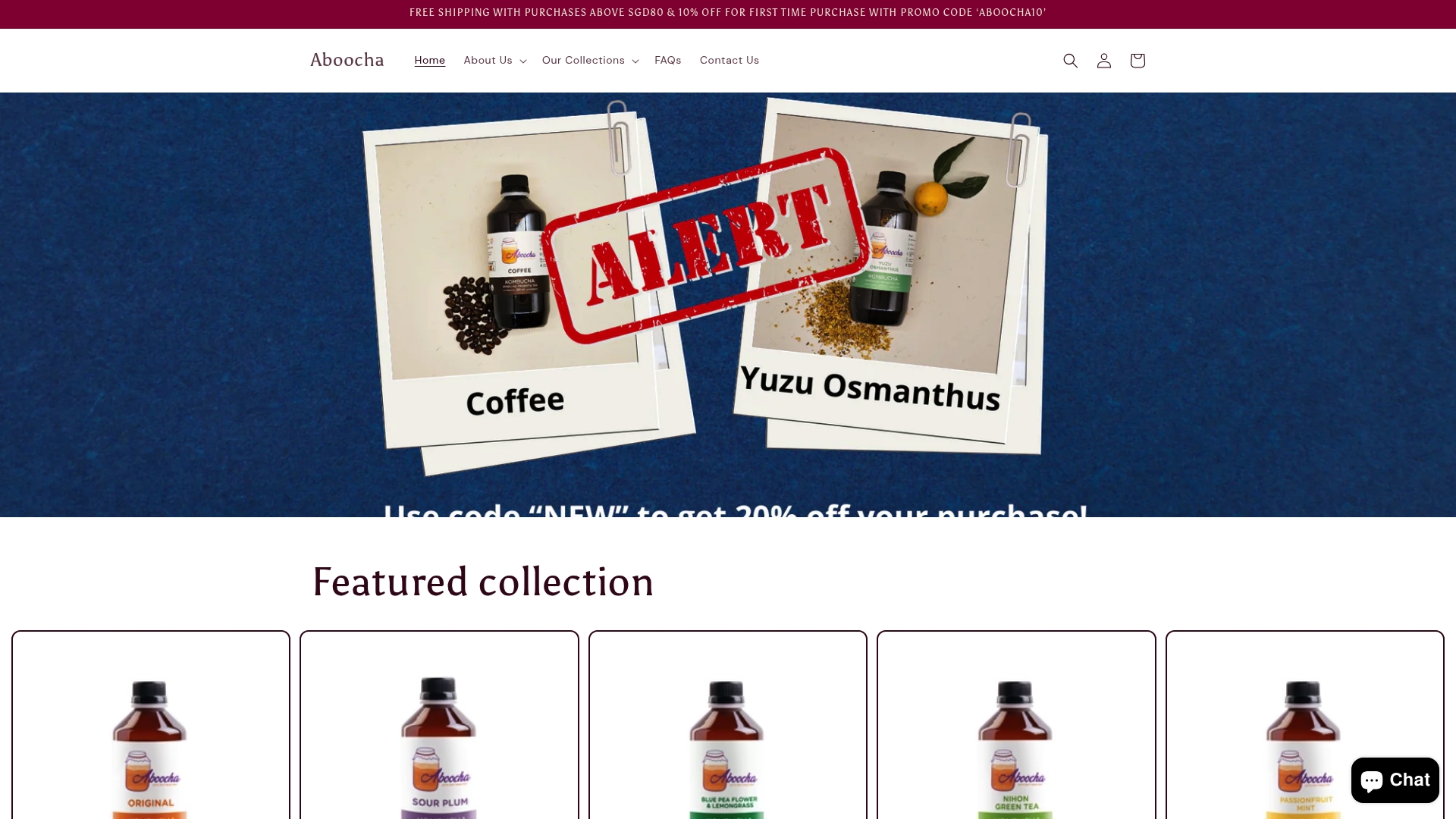
The bundle options are built for people who want a consistent pantry supply without committing to a single flavor. For workplaces or households that go through kombucha regularly, the corporate pantry system handles restocking automatically. Check current bundle availability and start your first order at Aboocha’s website.
This article is general nutritional information, not professional dietary advice. Confirm current Swiss guidelines and your personal needs with a registered dietitian or the FSVO directly.
Useful sources and further reading
- Swiss Federal Food Safety and Veterinary Office (FSVO/BLV) — primary source for Switzerland’s 50 g/day free-sugar guideline and voluntary reformulation policy
- menuCH National Nutrition Survey — Free Sugar in Switzerland — population-level data on beverage contributions to free sugar intake
- Systematic Review: Kombucha and Microbiota/Metabolic Health (MDPI Fermentation) — clinical trial evidence on digestive effects, organic acids, and realistic sugar levels
- RCT: Fiber-Modified Kombucha and Gut Microbiota (PMC) — evidence for synbiotic benefit of fiber-enhanced kombucha
- Cleveland Clinic: Kombucha Benefits and Safety — dietitian guidance on label reading, serving size, and adverse effects
- BLV Carbohydrate Recommendations (PDF) — Swiss Federal Commission for Nutrition guidance on sugar alcohols and special populations
FAQ
How much sugar should a low-sugar kombucha have per serving?
Aim for kombucha with 1–3 g of sugar per 100 mL; a 330 mL bottle at that level typically delivers 5–10 g of free sugars, well within Switzerland’s 50 g/day guideline.
Does kombucha actually help with digestion?
Clinical trials show reduced constipation complaints and modest gut microbiota shifts, but study designs vary enough that effects are promising rather than conclusively proven.
What hidden sugars should I watch for on a kombucha label?
Fruit juice concentrates, honey, agave syrup, and post-fermentation flavored syrups all count as free sugars — check the ingredient list and the added sugar line on the NIP, not just the front-of-pack claim.
How much kombucha is safe to drink daily?
Clinical trials used 200–473 mL per day; starting at 200 mL and spacing it across meals reduces the risk of bloating or GI discomfort, especially for first-time drinkers.
Where can I find low-sugar kombucha in Switzerland?
Specialty health-food stores, organic grocers, farmers’ markets, and direct-to-consumer subscriptions are your most reliable channels. Aboocha offers subscription bundles with transparent sugar labeling for Swiss consumers.