
Floral notes in fermentation are defined as aromatic compounds produced when yeast enzymes and microbial communities chemically transform natural precursors like terpenes and esters into volatile molecules the nose detects as flowers, rose, or honey. This process is called biotransformation, and it explains why floral notes develop during fermentation across such different products as wine, kombucha, beer, and fermented tea. The key drivers are enzyme activity, microbial strain selection, and fermentation conditions. Understanding these three levers gives you real control over the aroma profile of any fermented product.
Why do floral notes develop during fermentation?
Floral aromas originate from enzymatic biotransformation, a process where yeast enzymes chemically modify odorless or mildly scented precursor molecules into volatile aromatic compounds. The precursors are naturally present in raw ingredients: grape skins carry terpenes, hops contain aromatic oils, and flowers like osmanthus hold glycoside-bound aroma molecules. Yeast enzymes unlock these molecules during fermentation, releasing the scents you perceive as floral.
Two enzymes sit at the center of this process. The enzyme β-glucosidase cleaves glycosidic bonds, freeing bound terpenes from their sugar carriers so they become volatile and detectable. The enzyme β-lyase converts sulfur-containing precursors into aromatic thiols. Together, these enzymes transform geraniol into citronellol, shifting the aroma character from a rose note toward a softer citrus-floral quality. That single enzymatic step explains why the same grape variety can smell different depending on which yeast strain ferments it.
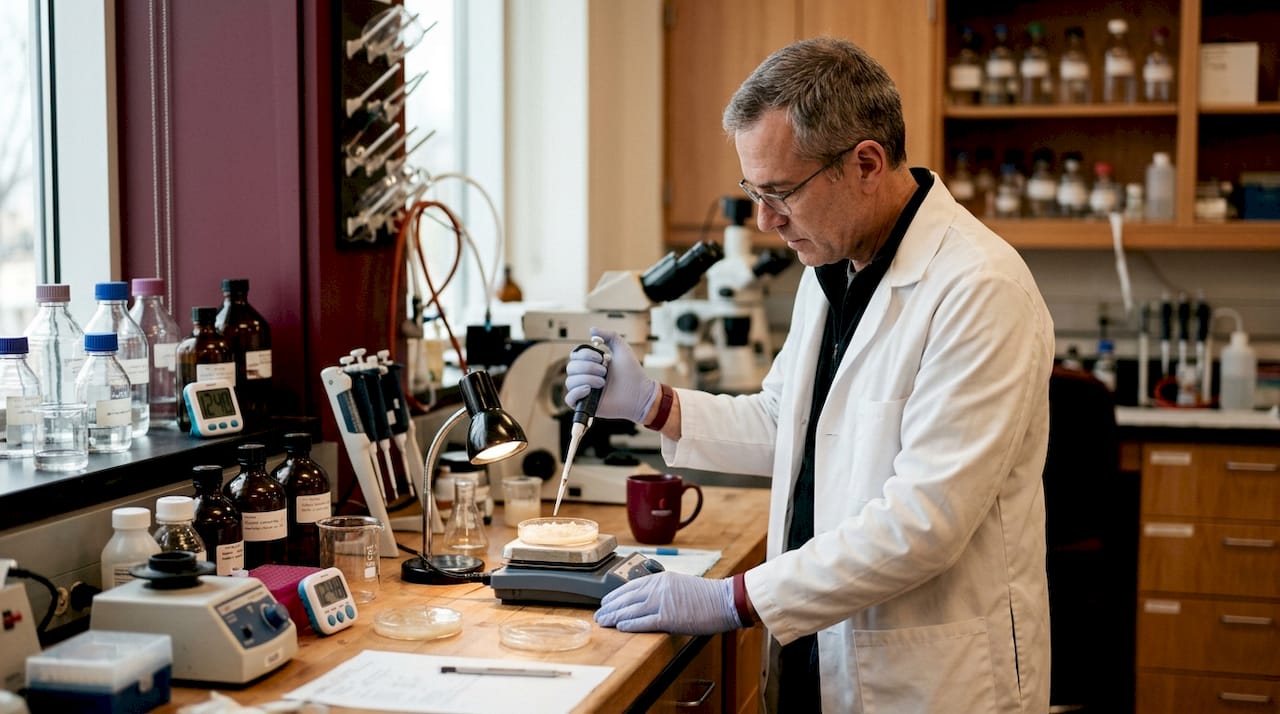
Yeast strain genetics determine how much enzymatic activity occurs. Strains with higher β-glucosidase expression release more free terpenes from the same raw material. This is why strain selection is the first practical lever any fermenter can pull to shape floral character.
How yeast enzymes biochemically create floral aromas
The biochemical pathway from precursor to floral aroma follows a clear sequence. Raw ingredients supply terpene glycosides, amino acid derivatives, and fatty acids. Yeast enzymes cleave, reduce, or esterify these molecules into volatile forms. The resulting compounds reach the headspace of the liquid and register as aroma.
Key compounds produced through this pathway include:
- Geraniol and linalool: Terpenes released by β-glucosidase from grape or hop glycosides, carrying rose and lavender notes
- Citronellol: Formed when β-lyase or reductase enzymes convert geraniol, adding a softer, citrus-floral quality
- 2-Phenylethyl acetate: An ester synthesized by yeast from phenylethanol and acetyl-CoA, producing a strong rose and honey aroma
- Phenylethyl alcohol (2-PE): A higher alcohol with a rose-like scent, produced via the Ehrlich pathway from phenylalanine
Saccharomyces cerevisiae produces esters and higher alcohols through metabolic pathways that depend on cofactor availability, particularly NADH and acetyl-CoA. When cofactor balance shifts, ester output changes. That is why the same yeast strain can produce different floral intensities across different batches if nutrient conditions vary.
Pro Tip: Add a small amount of yeast assimilable nitrogen (YAN) early in fermentation to support phenylethanol synthesis. Low YAN starves the Ehrlich pathway and reduces rose-type aromas.
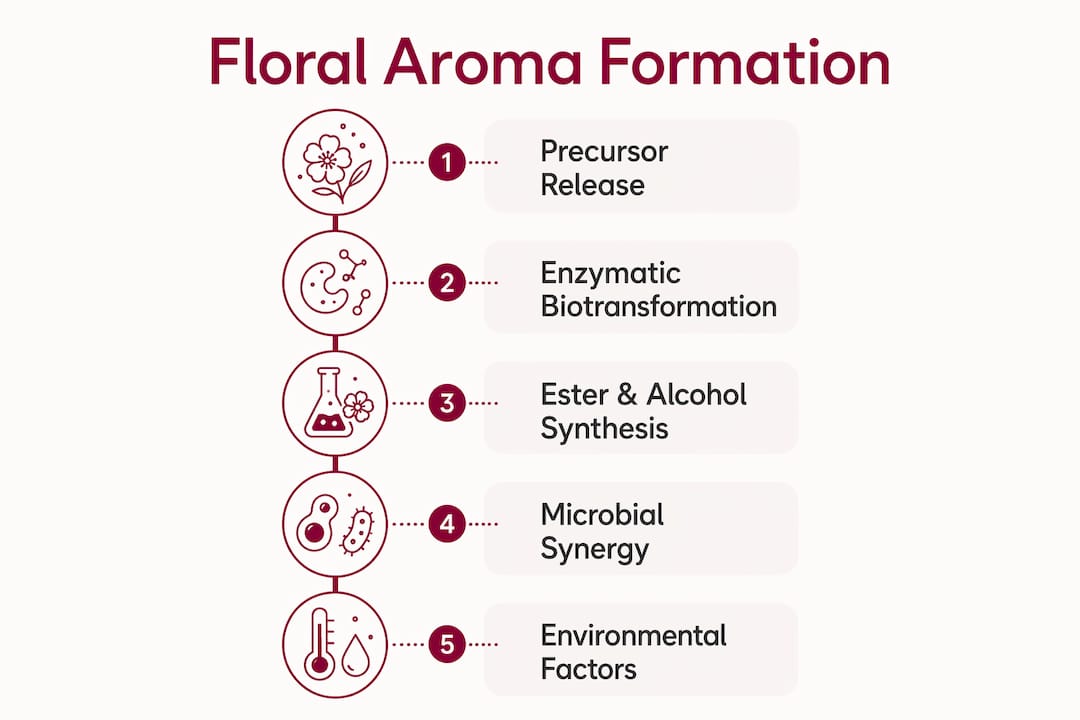
Fermentation stage also matters. Early fermentation favors ester synthesis because yeast is metabolically active and acetyl-CoA is abundant. Later stages shift toward ester hydrolysis as ethanol accumulates. Timing your harvest or transfer to capture peak ester concentration is a practical skill that separates flat floral profiles from vivid ones.
How does microbial ecology shape floral aroma expression?
Floral aroma in fermentation is rarely the product of a single organism. Microbial communities interact, compete, and cooperate in ways that amplify or suppress specific aromatic compounds. Understanding this ecology gives you a more complete picture of how complex flavors form in fermented products.
Research on Pu’er tea fermentation shows that floral notes result from multi-microbial synergy, where specific bacterial populations drive the accumulation of phenylethyl alcohol and trans-β-ionone. No single microbe produces the full floral profile. The community composition, shaped by moisture content and substrate, determines which compounds accumulate. This finding applies broadly to kombucha, wine, and fermented grain beverages.
Non-Saccharomyces yeasts play a particularly important role. The yeast Hanseniaspora vineae produces elevated 2-phenylethyl acetate, dramatically increasing rose and honey aromas in fermented cider compared to standard Saccharomyces strains. This is possible because H. vineae carries multiple gene copies for floral acetate ester synthesis that typical strains lack. The implication is direct: choosing a non-Saccharomyces strain is one of the most effective ways to push floral intensity.
Bacterial species also contribute. Certain Pseudomonas and Aspergillus strains produce enzymes that modify phenolic precursors into aromatic aldehydes and alcohols. Flower extracts added to fermentation substrates restructure microbial communities in ways that favor aroma-positive populations. Extracts from flowers like Prunus mume boost aroma content by over 32% while reducing undesirable alkaloids and nitrogen compounds. That result reflects a microbial community shift, not just a direct chemical contribution from the flower itself.
What fermentation conditions control floral note intensity?
Process variables shape floral aroma as much as microbial strain selection does. Temperature, ethanol concentration, timing, and substrate choice each affect the enzymatic reactions that produce floral compounds.
Temperature and enzyme activity
Temperature controls enzyme reaction rates directly. Lower fermentation temperatures (12–16°C for wine, for example) slow yeast metabolism but favor ester retention because ester hydrolysis is also slowed. Higher temperatures accelerate ester synthesis but also accelerate loss of volatile compounds to evaporation. The practical result is that cooler, slower fermentations tend to produce more delicate, persistent floral notes.
Ethanol concentration and gene expression
Ethanol stress at moderate concentrations upregulates the ester synthesis genes ATF1, EHT1, and EEB1 in brewing yeast. Ethanol-driven gene expression increases production of fatty acid ethyl esters, which contribute soft floral and fruity notes. Very high ethanol levels suppress these genes, reducing floral output. This means fermentations that reach moderate alcohol levels before slowing down often produce the richest floral profiles.
Substrate and flower extract additions
The substrate you ferment determines the precursor pool available to yeast enzymes. Flower-rich substrates supply more terpene glycosides and phenolic precursors. A concentration of 0.5% Clitoria ternatea flower extract optimizes floral aroma in fermented foods without negative effects on texture or overall flavor. That threshold matters because higher concentrations can introduce astringency or off-notes that mask the floral character you are trying to build.
| Fermentation variable | Effect on floral notes | Practical target |
|---|---|---|
| Temperature | Lower temps preserve volatile esters | 12–18°C for floral-forward profiles |
| Ethanol level | Moderate ethanol upregulates ester genes | Aim for moderate ABV range |
| Flower extract dose | Restructures microbial community, boosts aroma | 0.5% concentration as starting point |
| Fermentation timing | Early stages favor ester synthesis | Capture or transfer at peak ester phase |
Pro Tip: Ferment at the lower end of your yeast strain’s temperature range for the first 48–72 hours. This early cool phase builds ester concentration before ethanol rises and begins suppressing synthesis genes.
What are the key floral compounds formed during fermentation?
Floral aromas in fermented products come from three main chemical classes: esters, terpenes, and norisoprenoids. Each class has a distinct sensory character and a different biochemical origin.
Floral and fruity aroma compounds in beer and wine depend on trace esters with very low sensory thresholds. This means a concentration change of just a few parts per billion can shift a product from neutral to intensely floral. That sensitivity explains why small changes in yeast strain, temperature, or substrate produce dramatic differences in the finished aroma.
| Compound | Chemical class | Sensory character | Typical source |
|---|---|---|---|
| 2-Phenylethyl acetate | Ester | Rose, honey | Yeast ester synthesis from phenylalanine |
| Linalool | Terpene | Lavender, floral | Released from glycoside precursors by β-glucosidase |
| Geraniol | Terpene | Rose, geranium | Hop and grape skin glycosides |
| Citronellol | Terpene | Soft rose, citrus | Enzymatic reduction of geraniol |
| Trans-β-ionone | Norisoprenoid | Violet, woody floral | Carotenoid degradation during fermentation |
| Phenylethyl alcohol | Higher alcohol | Rose, mild floral | Ehrlich pathway from phenylalanine |
The norisoprenoid trans-β-ionone deserves special attention. It forms from the breakdown of carotenoid pigments during fermentation, not from terpene glycosides. Its violet and woody-floral character adds depth to profiles that would otherwise read as one-dimensional rose or citrus. Fermented teas and some wine styles owe their complexity partly to this compound.
How can you enhance floral aromas in fermented products?
Controlling floral aroma requires deliberate choices at every stage of the fermentation process. The following practices produce consistent results across kombucha, wine, cider, and fermented tea.
- Select non-Saccharomyces yeast strains. Hanseniaspora vineae and similar strains produce significantly more 2-phenylethyl acetate than standard strains. Use them as a co-inoculant with Saccharomyces to combine floral intensity with reliable fermentation completion.
- Add flower extracts at controlled concentrations. Start at 0.5% flower extract by weight and adjust based on sensory evaluation. Extracts from osmanthus, rose, or Prunus mume supply both precursors and microbial community shifts that favor aroma-positive organisms.
- Ferment cool and slow. Lower temperatures preserve volatile esters and reduce evaporative loss of key floral compounds. A slower fermentation also gives non-Saccharomyces yeasts more time to contribute before Saccharomyces dominates.
- Monitor fermentation timing. Floral ester concentration peaks during active fermentation and declines as ethanol rises. Tasting at regular intervals and transferring or packaging at peak aroma is more reliable than following a fixed timeline.
- Manage nitrogen levels. Adequate yeast assimilable nitrogen supports the Ehrlich pathway for phenylethanol and 2-phenylethyl acetate production. Deficiency suppresses floral output even when all other conditions are correct.
Pro Tip: For kombucha, add osmanthus flowers to the second fermentation vessel rather than the primary ferment. This preserves delicate floral volatiles that would otherwise be driven off by CO2 during active primary fermentation.
The fermentation flavor combinations that work best in practice pair floral notes with mild acidity and low residual sugar. High sugar masks floral volatility. High acidity, when balanced, sharpens floral perception by contrast.
Key Takeaways
Floral notes develop during fermentation because yeast enzymes and microbial communities convert odorless precursor molecules into volatile aromatic compounds through a process called biotransformation.
| Point | Details |
|---|---|
| Biotransformation drives floral aromas | Enzymes β-glucosidase and β-lyase release and convert terpenes into volatile floral compounds. |
| Strain selection is the primary lever | Non-Saccharomyces yeasts like Hanseniaspora vineae produce far more floral esters than standard strains. |
| Temperature shapes ester retention | Cooler fermentation temperatures preserve volatile esters and produce more persistent floral notes. |
| Microbial community matters | Multi-species fermentation synergy, as seen in Pu’er tea, drives accumulation of key floral compounds. |
| Flower extracts restructure aroma | Adding flower extracts at 0.5% concentration boosts floral aroma content and shifts microbial communities favorably. |
Floral aromas are more ecology than chemistry
The science of floral aroma development surprised me the first time I read deeply into it. I expected a clean story: yeast makes ester, ester smells like rose, done. The reality is messier and far more interesting.
What actually happens is closer to an ecosystem event. The microbial community shifts in response to substrate, temperature, and oxygen. Those shifts determine which enzymatic pathways dominate. The enzymatic pathways determine which precursors get converted and at what rate. The resulting aroma is a snapshot of a living system at a specific moment in time. That is why the same recipe, the same yeast packet, and the same flowers can produce a noticeably different floral profile from one batch to the next.
The practical lesson I take from this is to stop treating floral aroma as a fixed target and start treating it as a range to manage. You can shift that range significantly by choosing the right yeast strain, controlling temperature in the first 48 hours, and adding flower extracts at the right concentration. But you cannot fully predict the outcome, and that unpredictability is part of what makes fermentation worth studying. The fermentation-driven flavor profiles that feel most alive are the ones where the microbial ecology had room to do something unexpected.
— Luna
Aboocha and the science of fermentation flavor
Aboocha builds its kombucha flavors around exactly the kind of biochemical precision this article describes. The Yuzu Osmanthus variety, for example, uses osmanthus flowers as a fermentation substrate, applying the same principle that Prunus mume extracts use: flower additions restructure microbial communities and supply terpene precursors that yeast enzymes convert into floral volatiles.

Aboocha’s lower sugar formulas also support floral aroma perception directly. Reduced residual sugar allows volatile floral compounds to reach the nose without being masked. If you want to taste what deliberate floral fermentation science produces in a finished beverage, explore Aboocha’s kombucha lineup and see how strain selection and substrate choice translate into a glass. The fermentation science covered here is not theoretical for Aboocha. It is the production method.
FAQ
What causes floral notes to appear in fermented drinks?
Floral notes appear when yeast enzymes like β-glucosidase and β-lyase convert odorless terpene precursors into volatile aromatic compounds during fermentation. The process is called biotransformation and occurs continuously throughout active fermentation.
Which yeast strains produce the most floral aromas?
Hanseniaspora vineae produces significantly higher levels of 2-phenylethyl acetate than standard Saccharomyces cerevisiae strains, resulting in strong rose and honey aromas. Non-Saccharomyces yeasts generally outperform standard strains for floral ester production.
Does fermentation temperature affect floral aroma intensity?
Lower fermentation temperatures preserve volatile esters and slow their hydrolysis, producing more persistent and intense floral notes. Fermenting at the cooler end of a yeast strain’s range during the first 48–72 hours builds the strongest floral foundation.
Can adding flowers to fermentation increase floral aromas?
Flower extracts at a 0.5% concentration optimize floral aroma in fermented products without introducing off-flavors or texture problems. Flower additions also restructure microbial communities in ways that favor aroma-positive organisms, amplifying the effect beyond simple precursor addition.
Why do floral aromas vary so much between batches?
Floral aroma development depends on multi-microbial synergy, enzyme activity, and fermentation conditions that all shift slightly between batches. Even small changes in temperature, nitrogen levels, or microbial community composition produce measurable differences in floral compound accumulation.