
Flavor profiles for health-focused kombucha are built by combining a sweetness/acid backbone with layered aroma compounds, controlled fermentation parameters, and mouthfeel correction — all tested in the final beverage system, not a neutral lab base.
Before you buy or evaluate any kombucha, here is what the development process actually controls:
- Sweetness (Brix or equivalent): residual sugar level and any sweetener blend used to restore body in low-sugar builds
- Acidity: type (acetic, lactic, gluconic) and titratable acidity, which together set tartness and perceived brightness
- Aroma: top notes (citrus, floral), mid notes (fruity, herbal), and base notes (bready, honey) driven by volatile organic compounds
- Microbial composition: the SCOBY’s yeast and bacteria strains, which determine which VOCs are produced and when
- Carbonation: affects perceived acidity and aroma release
- Temperature and storage: alter volatility of top notes and shelf stability
- Shelf stability: pH, packaging headspace oxygen, and accelerated aging tests
What to look for on a label: clear residual sugar disclosure, titratable acidity or pH, named functional ingredients with declared amounts, and any sensory testing language. Brands that publish these details have usually done the work.
Table of Contents
- How flavor profiles are developed: the five core building blocks
- Why you must test in the actual beverage system from day one
- How developers handle off-notes from functional ingredients
- Practical sensory testing and iteration protocols
- What the development timeline and costs actually look like
- Swiss regulatory signposts for selling a new kombucha flavor
- How Aboocha builds low-sugar, flavor-forward kombucha
- Key Takeaways
- Why flavor-first development is the only approach worth taking
- FAQ
- Further reading and references
How flavor profiles are developed: the five core building blocks
Every kombucha flavor rests on five sensory dimensions. In low-sugar, functional builds, each one behaves differently than it does in a conventional sweetened drink.
| Building Block | What Developers Measure | Low-Sugar Consideration |
|---|---|---|
| Sweetness | Brix, sweetener profile | Body loss requires aroma/acid compensation |
| Acidity | Titratable acidity, pH | Must stay bright without turning sharp |
| Aroma | VOC kinetics, odor-active compound panel | Top notes volatilize faster; base notes carry the finish |
| Bitterness/Tannin | Sensory panel score, polyphenol level | Tea type and steep time set baseline bitterness |
| Mouthfeel | Viscosity, carbonation level, dissolved solids | Carbonation and dissolved solids replace lost sugar body |
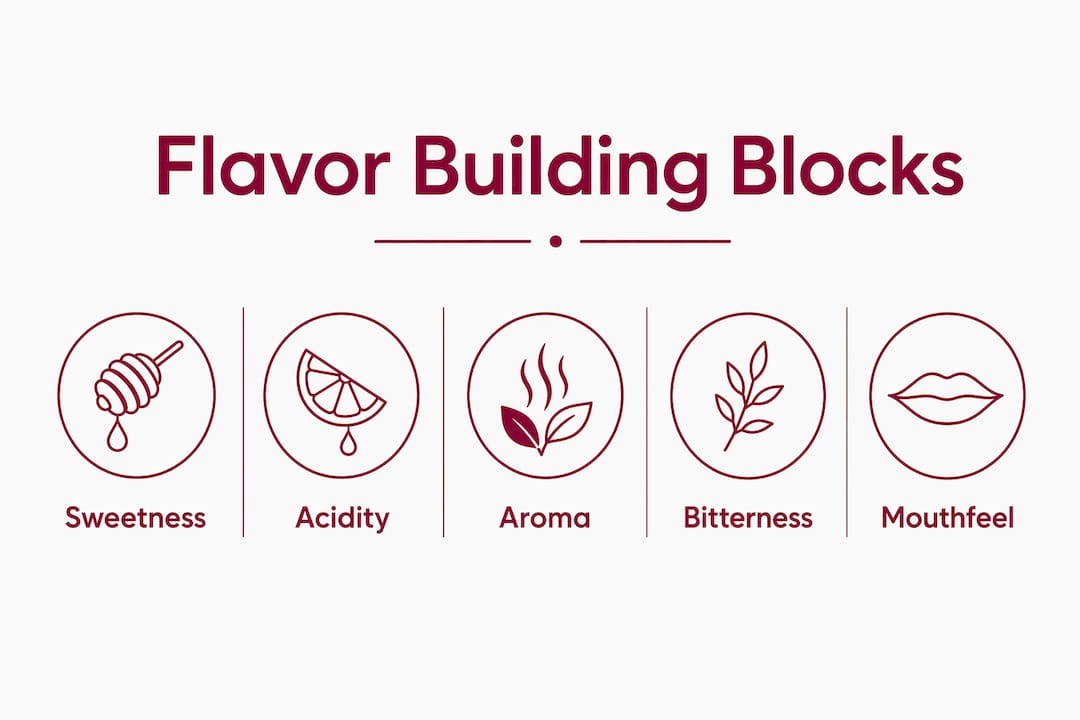
Sweetness anchors the whole perception stack. Cut it without compensating and the drink reads as sharp or thin — what formulators call “spiky.” Low-sugar systems need blended sweeteners and dissolved-solids correction to restore roundness.
Acidity is the most underestimated lever. Acetic, lactic, and gluconic acids each have distinct mouthfeel signatures. Acetic reads sharp and vinegary; lactic is softer and rounder; gluconic adds a mild, almost mineral brightness. Blending all three gives developers far more control than relying on a single acid.
Aroma is where kombucha gets interesting. Research using SBSE-GC-MS detected 87 VOCs in kombucha, with 17 identified as odor-active. Early fermentation produces citrus-floral notes from geraniol and linalool; later stages shift toward sweet-floral-bready-honey character driven by 2-phenylethanol. Controlling when you stop fermentation is, in effect, choosing your aroma register.
Bitterness from tea polyphenols and tannins sets the adult, dry character that distinguishes kombucha from juice. Green tea ferments slower and produces a different sugar/acid ratio than black tea, which changes perceived sweetness and flavor acceptability depending on inoculum age.
Pro Tip: In zero/low-sugar builds, dissolved solids (from tea concentration, added minerals, or soluble fiber) can rescue thin mouthfeel without adding sweetness. A higher dissolved-solids baseline also buffers carbonation’s sharpening effect on perceived acidity.
Why you must test in the actual beverage system from day one
A flavor that tastes balanced in still, room-temperature water can fall apart the moment you carbonate it, chill it, or run it through pasteurization. This is the single most common and costly mistake in beverage development.
Key interaction effects to watch:
- pH shifts change anthocyanin pigment and can alter aroma perception — a berry-forward note can turn flat or medicinal at lower pH
- Carbonation elevates perceived acidity and accelerates volatilization of top notes, making a citrus profile read sharper than intended
- Pasteurization heat can collapse delicate floral top notes entirely
- Cold storage vs. ambient changes how quickly base notes dominate the finish
- Packaging headspace oxygen drives oxidation that produces off-notes over shelf life
Early-stage stability checklist:
- pH measurement at production and at 4, 8, and 12 weeks
- Accelerated shelf test (elevated temperature, typically 37°C for 4 weeks)
- Cold chain vs. ambient comparison at target retail temperature
- Packaging headspace oxygen measurement
- Post-pasteurization sensory check against the pre-pasteurization benchmark
Flavor performance changes with packaging, carbonation, pH, and storage temperature — prototypes must be tested in the intended system to avoid flavor collapse during scale-up. The surface area to volume ratio in fermentation vessels also affects dissolved oxygen and microbial activity, which means SA/V changes glucose/fructose and gluconic acid formation and can shift the final flavor balance when you move from a small tank to a commercial vessel.
Pro Tip: Run mini pilot batches in the exact target packaging at the target storage temperature before locking the formula. Metallic off-notes and carbonation “collapse” almost always show up here first, not on the bench.
How developers handle off-notes from functional ingredients
Adaptogens, minerals, and botanical extracts are the hardest ingredients to work with. They carry inherent bitterness, astringency, or metallic aftertaste that cannot simply be covered with more fruit flavor.
Masking a problematic ingredient late in development almost always produces an unstable or “fake” flavor profile. The fix is to identify the off-note source at concept stage, before the rest of the formula is locked.
Common off-note sources and their signatures:
- Minerals (magnesium, zinc, iron): metallic, chalky aftertaste that intensifies at lower pH
- Adaptogens (ashwagandha, reishi): earthy, bitter, sometimes musty — concentration-dependent
- Botanicals (elderflower, hibiscus): astringency from polyphenols; hibiscus can turn aggressively tart under high carbonation
Step checklist for R&D teams:
- Identify the off-note by tasting each functional ingredient in isolation at target concentration
- Trace it to the ingredient or process step (e.g., pH drop amplifying mineral metallic note)
- Test masking options: acid balancing, aroma layering over the off-note frequency, sweetness modifiers
- Re-evaluate the masked formula at target pH and carbonation level
- Run a stability check — some masking solutions degrade faster than the off-note they cover
Functional ingredients like minerals or adaptogens carry inherent bitterness or metallic notes that must be guided or masked early, not simply covered with more flavor later. Acidity balancing is often the most effective first move — understanding how acidity balances sweetness in a formula can neutralize metallic perception before any masking agent is needed.
Pro Tip: Aroma layering works by placing a high-volatility top note directly over the frequency of the off-note. A bright citrus or floral top note can redirect attention away from a bitter mid-note — but only if the base note is clean. Fix the base first.
Practical sensory testing and iteration protocols
A compact, repeatable sensory protocol separates brands that guess from brands that know. The standard sequence runs: bench prototypes → trained internal panel (5–8 people) → blind consumer validation.
Iteration log template (record each round):
| Variable | What to Record |
|---|---|
| Brix | Measured at production |
| pH | Measured at production and after 2 weeks |
| Aroma notes | Top/mid/base descriptors from panel |
| Mouthfeel descriptors | Carbonation level, viscosity, finish length |
| Acceptance score | Panel average (1–9 hedonic scale) |
| Change made | Single variable altered this round |
Numbered iteration cycle (expect 6–12 rounds for a stable recipe):
- Bench prototype with base tea, SCOBY, and target sugar level
- Internal panel blind tasting — score aroma, acidity, mouthfeel, finish
- Identify the weakest attribute; change one variable only
- Repeat tasting with the adjusted prototype alongside the previous version
- After three consecutive rounds without a score improvement, move to pilot batch
- Pilot batch sensory check in final packaging at target carbonation and temperature
- Accelerated shelf test (4 weeks at elevated temperature)
- Post-stability panel — compare against the pre-stability benchmark
- Blind consumer validation (minimum 30 respondents)
- Incorporate consumer feedback; make final adjustments
- Lock the formula and document all parameters
- First commercial batch sensory audit against the locked benchmark
Beverage R&D best practices recommend disciplined iteration logs and structured sensory scorecards — change one variable at a time and benchmark against two or three category references. Lab-scale prototypes can behave differently under industrial processing conditions, so pilot runs under real conditions are non-negotiable before commercial launch.
What the development timeline and costs actually look like
| Phase | Typical Duration | Key Outputs |
|---|---|---|
| Concept and ingredient sourcing | 2–4 weeks | Tea type, SCOBY selection, functional ingredient list |
| Bench prototyping | 4–8 weeks | 3–5 prototype variants, initial sensory scores |
| Sensory iterations | 6–12 weeks | Locked formula, iteration log, stability baseline |
| Pilot production | 4–6 weeks | Pilot batch in final packaging, GC-MS aroma profile |
| Stability and scale-up | 8–12 weeks | Shelf-life data, scale-up parameter adjustments |
| Launch preparation | 4–6 weeks | Final label review, regulatory sign-off, production brief |
Cost drivers scale sharply with complexity. Functional ingredient sourcing adds cost when adaptogens or rare botanicals require certified supply chains. GC-MS aroma profiling is a meaningful line item but pays for itself by catching aroma drift before a full production run. Packaging tooling and validation are often underbudgeted by small-batch producers moving to commercial scale.
Label and claim decisions — “natural flavor,” “no artificial flavors,” certifications — materially affect ingredient selection and formulation timelines. Treating flavor, functionality, and labeling as a single decision from day one avoids the most expensive scenario in beverage development.
Pro Tip: The two biggest budget killers are late-stage label changes (reformulating to meet a “natural” claim after the formula is locked) and last-minute stability failures that require a full re-run of the shelf-life study. Both are avoidable if regulatory requirements are mapped before bench work begins.
Swiss regulatory signposts for selling a new kombucha flavor
Switzerland’s food law framework sits under the Lebensmittelgesetz (LMG) and its implementing ordinances, enforced by the Bundesamt für Lebensmittelsicherheit und Veterinärwesen (BLV). For kombucha specifically, several points matter:
- Alcohol threshold: kombucha is a fermented beverage and may contain residual alcohol. Swiss law sets the threshold for labeling a beverage as “non-alcoholic” at 0.5% ABV — producers must measure and declare if the product approaches this level.
- Sugar declaration: residual sugar must be declared in the nutrition table per 100 ml under the Swiss Nutrition Labeling Ordinance.
- “Natural flavor” claims: Switzerland follows a definition aligned with EU Regulation 1334/2008 for flavor naming. “Natural” requires the flavoring substance to be derived exclusively from natural sources — verify with your flavor supplier before printing.
- Health claims: functional claims (e.g., “supports gut health”) are regulated under the Verordnung über die Kennzeichnung und Anpreisung von Lebensmitteln (LKV). Only claims on the Swiss-permitted list are allowed without a specific authorization.
- Allergen declaration: any allergenic ingredient (e.g., certain botanical extracts) must be declared in the ingredient list.
- Organic certification: if claiming organic, certification must come from a body accredited under Swiss organic ordinance (Bio-Verordnung).
Verify current thresholds and permitted claims directly with the BLV or a Swiss food law specialist before finalizing labels. Requirements update periodically and the consequences of a non-compliant label at retail are significant. For practical guidance on new beverage flavors in the Swiss market, cross-referencing regulatory requirements with your co-manufacturer early saves reformulation costs later.
How Aboocha builds low-sugar, flavor-forward kombucha
Aboocha’s product range maps directly onto the development principles above. Flavors like Sour Plum and Yuzu Osmanthus are not arbitrary combinations — they reflect deliberate aroma architecture. Sour Plum pairs a lactic acid backbone with stone-fruit mid notes and a clean, dry finish. Yuzu Osmanthus layers a high-volatility citrus top note over a floral base that holds through carbonation and cold storage.
Flavor-first development is not decoration. For a low-sugar kombucha, the aroma and acid architecture is the product — it replaces the body and sweetness that sugar would otherwise provide.
Aboocha emphasizes lower sugar content across its range, which means the mouthfeel and finish work described above is not optional — it is the core technical challenge the brand solves with each new flavor. Sensory panel testing and stability testing are part of the development process, with supporting the outcomes customers report.
The subscription model Aboocha offers is itself a signal of flavor confidence: repeat purchase only happens when the flavor holds up batch to batch, bottle to bottle.
Pro Tip: Standardizing the inoculum (SCOBY age, starter liquid ratio) and tracking batch metadata (fermentation temperature, duration, Brix at harvest) is what separates consistent commercial kombucha from batch-variable small-batch production. Aboocha’s approach to scale treats these parameters as non-negotiable controls, not suggestions.
Key Takeaways
Developing a great kombucha flavor profile requires controlling five sensory building blocks, testing in the final beverage system from the start, and treating label claims as formulation constraints, not afterthoughts.
| Point | Details |
|---|---|
| Five building blocks | Sweetness, acidity, aroma, bitterness, and mouthfeel must all be tuned for low-sugar builds. |
| Test in the real system | Carbonation, pH, and storage change flavor — bench testing alone will mislead you. |
| Handle off-notes early | Identify functional ingredient off-notes at concept stage; late masking produces unstable profiles. |
| Iterate with discipline | Expect 6–12 sensory iterations; change one variable per round and log everything. |
| Swiss labeling matters | Alcohol threshold, sugar declaration, and health claims are all regulated under Swiss law. |
Ready to taste what rigorous flavor development actually produces? Explore Aboocha’s flavor sets and find the profile that fits your palate.
Why flavor-first development is the only approach worth taking
Most functional beverage brands treat flavor as the last problem to solve. Get the health benefit right, then add enough fruit to make it drinkable. That logic produces products people try once.
The evidence points the other way. A kombucha that tastes medicinal, thin, or chemically sharp will not be repurchased — regardless of what the label promises for gut health. Flavor is not the wrapper around the function. For a low-sugar fermented beverage, the aroma and acid architecture is the functional delivery system, because it determines whether someone finishes the bottle and orders another.
Aboocha’s approach — building flavor profiles like Yuzu Osmanthus and Sour Plum from the acid backbone up, with deliberate aroma layering and mouthfeel correction for low-sugar systems — reflects a development philosophy where sensory quality and health positioning reinforce each other rather than compete. That is what makes a kombucha worth subscribing to, not just sampling.
FAQ
What are the main factors influencing kombucha flavor?
Tea type, initial sugar concentration, fermentation temperature, and microbial composition are the primary drivers. Research shows fermentation temperature affects the most sensory attributes, followed by initial sugar concentration.
How many iterations does it take to develop a stable kombucha recipe?
Beverage R&D best practices recommend expecting 6–12 iterations for a stable recipe, changing one variable per round and benchmarking against two or three reference products.
Why does low-sugar kombucha taste different from regular kombucha?
Reducing sugar removes body and roundness. Without aroma and acidity compensation, the result reads as sharp or thin. Developers use dissolved solids, blended acids, and aroma layering to restore mouthfeel without adding sugar.
What Swiss regulations apply to selling kombucha?
Kombucha sold in Switzerland falls under the Lebensmittelgesetz and BLV ordinances, covering alcohol threshold labeling (0.5% ABV), sugar declaration, natural flavor definitions, and permitted health claims under the LKV.
How does microbial composition affect kombucha aroma?
The SCOBY’s yeast and bacteria strains determine which volatile compounds are produced. Research confirms microbial composition is the strongest single factor in kombucha’s olfactive profile, stronger than tea type or production phase.
Further reading and references
- Characterization of Aroma Active Compound Production during Kombucha Fermentation — VOC kinetics during kombucha fermentation using SBSE-GC-MS; useful for understanding how aroma-active compounds evolve and how to control sensory profiles.
- Processing Condition Effects on Sensory Profiles of Kombucha — Trained descriptive panel study defining 63 kombucha sensory attributes; shows how tea type, sugar concentration, and fermentation temperature each affect flavor.
- Frontiers: Use of a Minimal Microbial Consortium to Determine the Origin of Kombucha Flavor — Identifies which yeast and bacteria interactions produce kombucha’s characteristic aroma compounds.
- Key Kombucha Process Parameters for Optimal Bioactive Compounds and Flavor Quality — Experimental data on how inoculum age, tea type, and SA/V ratio shift sugar/acid balance and flavor acceptability.
- Beverage Flavor Development: Concept to Consumer-Ready — Practical R&D guide covering system-matched testing, off-note management, and stability protocols.
- Accelerating Beverage Development: Concept to Shelf — Technical guidance on pilot runs and process-matched testing to avoid flavor loss at commercial scale.
- Beverage Recipe Development for Commercial Drink Success — Structured iteration methodology including scorecards, Brix:acid guidance, and zero-sugar formulation strategies.
- Built to Standout: A Product Development Philosophy — Industry analysis on treating flavor, functionality, and labeling as a single integrated decision to avoid late-stage reformulation costs.