
Butyrate is a four-carbon short-chain fatty acid produced when gut bacteria ferment dietary fiber in your large intestine. It is not a supplement trend or a wellness buzzword. It is the primary fuel source for colonocytes, the cells lining your colon, and without adequate butyrate, that lining weakens. A compromised gut lining lets bacteria and toxins cross into the bloodstream, triggering the kind of low-grade inflammation linked to conditions ranging from irritable bowel syndrome to metabolic disease.
Here is what butyrate does at a glance:
- Primary energy source for colonocytes, keeping the intestinal lining intact
- Anti-inflammatory agent that regulates immune cells and suppresses pro-inflammatory cytokines
- Epigenetic regulator that modifies gene expression by inhibiting histone deacetylase (HDAC) enzymes
- Microbiome architect that creates a low-oxygen environment in the colon, favoring beneficial bacteria over harmful ones
The connection between butyrate and gut health runs deeper than most people realize. Your diet determines how much your gut bacteria can produce, and that number varies more than you might expect.
How butyrate is produced and absorbed in the gut
Butyrate does not come from food directly. Your gut microbiota make it, primarily by fermenting dietary fibers you cannot digest yourself. Soluble fibers, resistant starches, and certain plant polysaccharides pass through the small intestine undigested and arrive in the colon, where bacteria break them down into short-chain fatty acids, butyrate being the most metabolically active of the three main ones.
The bacterial species doing most of this work belong largely to the Firmicutes phylum, particularly genera like Faecalibacterium, Roseburia, and Eubacterium. These are obligate anaerobes, meaning they thrive only in low-oxygen environments. When fiber intake drops, so does their activity, and butyrate production falls with it.
Butyrate is absorbed almost entirely by colonocytes before it ever reaches systemic circulation. The colon cells consume it as their preferred fuel, using it to power the tight junctions that keep the gut lining sealed. What little escapes into portal blood reaches the liver, where it is metabolized further. This localized consumption is why dietary fiber matters so much: the gut cells are essentially running on what your bacteria produce from what you eat.
Once absorbed, butyrate does more than generate energy. It activates G protein-coupled receptors (GPR41 and GPR43) on the surface of gut cells and immune cells, triggering signaling cascades that influence inflammation, hormone release, and gut motility. This receptor-level activity is part of why butyrate’s effects extend well beyond simple nutrition.
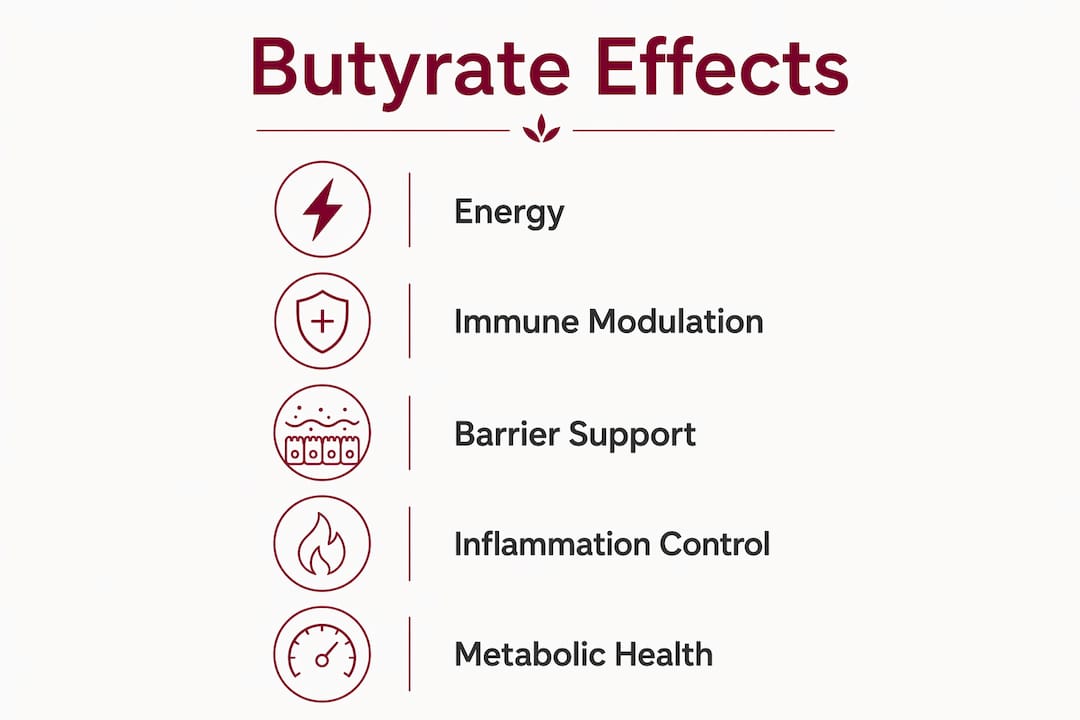
What butyrate actually does inside your gut cells
The physiological roles of butyrate operate at multiple levels simultaneously, from the physical structure of the gut wall to the regulation of your immune system.

Tight junction integrity. The gut lining is one cell thick. Tight junction proteins, including claudins and occludins, hold those cells together and prevent unwanted molecules from slipping through. Butyrate upregulates the expression of these proteins, physically reinforcing the barrier. When butyrate levels fall, tight junction expression drops, and permeability increases.
Immune modulation. Butyrate promotes the differentiation of regulatory T cells (Tregs) in the colon. Tregs are the immune system’s peacekeepers; they suppress excessive inflammatory responses without shutting down immunity entirely. By driving Treg production, butyrate helps the gut tolerate the trillions of bacteria living there without mounting a constant attack.
Epigenetic influence. Butyrate inhibits HDAC enzymes, which normally silence genes by compacting chromatin. When HDAC is blocked, certain anti-inflammatory and barrier-protective genes become more active. This is not a minor side effect. It means butyrate is influencing gene expression in ways that persist beyond its immediate presence in the cell.
Hypoxia-inducible factor (HIF) stabilization. Colonocytes consuming butyrate use oxygen rapidly, creating a naturally low-oxygen (hypoxic) environment in the colon lumen. This stabilizes HIF, a protein that further reinforces barrier function and reduces inflammation. It also happens to be exactly the environment that beneficial anaerobic bacteria need to survive.
- Butyrate strengthens tight junction proteins (claudins, occludins)
- Promotes regulatory T cell differentiation, reducing gut inflammation
- Inhibits HDAC enzymes, activating anti-inflammatory gene programs
- Stabilizes HIF, reinforcing the gut barrier at the molecular level
- Creates colonic hypoxia that supports beneficial anaerobic bacteria
Pro Tip: If you want to support butyrate production naturally, focus on fiber variety rather than fiber quantity alone. Different bacterial species ferment different fiber types, so eating a range of plant foods, including legumes, oats, green bananas, and cooked-then-cooled potatoes, feeds a broader community of butyrate-producing bacteria.
Health benefits and clinical evidence for butyrate
The clinical picture for butyrate is genuinely promising, though not without gaps. The strongest evidence sits in gastroenterology.
Gastrointestinal diseases
In inflammatory bowel disease (IBD), including Crohn’s disease and ulcerative colitis, butyrate-producing bacteria are consistently depleted. The same pattern appears in irritable bowel syndrome (IBS) and colorectal cancer. Whether low butyrate causes these conditions or results from them is still being worked out, but the association is consistent enough that butyrate supplementation and dietary interventions targeting butyrate production are active areas of clinical research.
Colorectal cancer research is particularly interesting. Butyrate’s HDAC-inhibiting activity suppresses the proliferation of cancer cells in laboratory studies and promotes apoptosis, the process by which damaged cells self-destruct. Clinical translation is still in progress, but the mechanistic case is solid.
Metabolic and systemic effects
Low levels of butyrate-producing bacteria associate with Type 2 Diabetes and obesity. Butyrate appears to improve insulin sensitivity partly through its effects on gut hormone secretion (GLP-1 and PYY) and partly through direct effects on energy metabolism in peripheral tissues. Swiss medical research has highlighted butyrate’s established role in treating gastrointestinal diseases while noting that expanding its application to metabolic and hematological conditions requires more clinical evidence.
What the data shows
| Condition | Butyrate’s documented role | Evidence level |
|---|---|---|
| Ulcerative colitis | Reduces mucosal inflammation, supports remission | Moderate (clinical trials) |
| Colorectal cancer | Inhibits cancer cell proliferation via HDAC inhibition | Preclinical + early clinical |
| Type 2 Diabetes | Associated with improved insulin sensitivity | Observational + mechanistic |
| IBS | Supports gut barrier, reduces permeability | Early clinical |
| Gut microbiome imbalance | Restores anaerobic bacterial dominance | Mechanistic + dietary studies |
One pattern stands out across the research: populations eating low-fiber, highly processed diets consistently show reduced butyrate-producing bacterial populations. The gut microbiome responds to what you feed it within days, not months.
How to increase butyrate production through diet
The most direct way to raise butyrate levels is to feed the bacteria that make it. That means dietary fiber, specifically the types that reach the colon intact.

Fermentation products like butyrate provide a modest portion of daily energy in a typical western diet. Traditional diets, such as those of the Hadza hunter-gatherers in Tanzania, reflect dramatically higher fiber intake and microbiome diversity, which influences fermentation product levels.
Top foods for butyrate production:
- Resistant starch sources: cooked-then-cooled potatoes, green bananas, legumes, and whole oats
- Prebiotic fibers: Jerusalem artichokes, chicory root, garlic, onions, and leeks (rich in inulin and fructooligosaccharides)
- Whole grains: barley, rye, and oats contain beta-glucan, a particularly effective fermentation substrate
- Legumes: lentils, chickpeas, and black beans deliver both soluble fiber and resistant starch
- Vegetables: asparagus, broccoli, and Brussels sprouts provide fermentable fiber alongside other phytonutrients
- Fermented beverages: kombucha and other probiotic-rich drinks support the bacterial populations that produce butyrate
Probiotics contribute indirectly. They do not produce large amounts of butyrate themselves, but they help maintain the microbial environment in which butyrate-producing bacteria thrive. Probiotic bacteria ferment dietary fibers into SCFAs including butyrate, which lower gut pH, support mineral absorption, and help regulate immune function and bowel regularity.
Lifestyle factors matter too. Chronic stress, poor sleep, and antibiotic use all reduce microbial diversity and, with it, butyrate output. Consistent physical activity associates with higher microbial diversity in observational studies, though the mechanism is not fully established.
Pro Tip: Cooking and cooling starchy foods like rice, pasta, and potatoes before eating them increases their resistant starch content. The cooling process causes starch to recrystallize into a form your small intestine cannot break down, sending more fuel to your colon bacteria.
Safety, side effects, and what to know before supplementing
Butyrate supplements are widely available, typically as sodium butyrate, calcium-magnesium butyrate, or tributyrin (a triglyceride form that releases butyrate during digestion). They are generally well tolerated, but a few things are worth knowing before you start.
Common side effects include bloating, gas, and mild digestive discomfort, particularly at higher doses or when starting supplementation. These usually resolve within a week or two as the gut adjusts. The smell of butyrate supplements, especially sodium butyrate, is notably unpleasant. Enteric-coated or microencapsulated forms address this and also improve delivery to the colon rather than the upper GI tract.
Who should consult a healthcare provider first:
- People with active IBD flares, as butyrate’s effects on inflammation can be complex during acute disease
- Anyone with a history of colorectal cancer or polyps, given butyrate’s dual role in cancer biology (it can behave differently in healthy versus cancerous cells)
- People taking immunosuppressive medications, since butyrate modulates immune function
- Pregnant or breastfeeding individuals, where evidence on supplementation safety is limited
On dosing: clinical studies have used a wide range of doses, and no universal therapeutic dose has been established. Most commercially available supplements fall in the 150–600 mg per day range. Starting at the lower end and increasing gradually reduces the likelihood of digestive side effects.
The most sustainable approach to butyrate is dietary rather than supplemental. Supplements can be useful for people with specific conditions or severely compromised gut microbiomes, but they do not replicate the sustained, fiber-driven production that a diverse gut microbiome generates around the clock. For most people, the better investment is in fermented drinks and gut health strategies that support the microbiome long-term.
What Swiss research reveals about butyrate and fermented product innovation
Switzerland has contributed meaningfully to the clinical understanding of butyrate, particularly in moving the conversation beyond gastroenterology. Swiss research documents butyrate’s established therapeutic use in gastrointestinal diseases and points toward expanding applications in metabolic disorders and hematology, while being clear that more rigorous clinical trials are needed before those applications become standard practice.
One finding with practical implications: butyrate’s consumption of oxygen by colonocytes creates a hypoxic niche in the colon that favors beneficial anaerobic bacteria over opportunistic pathogens. This is a self-reinforcing cycle. More butyrate means more anaerobes, which produce more butyrate, which sustains the hypoxic environment. Disrupting this cycle, through low fiber intake, antibiotics, or chronic illness, can be difficult to reverse without deliberate dietary intervention.
The gut’s anaerobic environment is not incidental. It is actively maintained by butyrate-producing bacteria and the colonocytes that consume their output. When that relationship breaks down, the colon becomes more hospitable to facultative aerobes, including several bacterial species associated with gut dysbiosis and systemic inflammation.
This is where fermented functional beverages enter the picture. Products designed to deliver live cultures alongside prebiotic substrates can support the bacterial populations that sustain butyrate production. Aboocha’s kombucha range, including varieties like Sour Plum and Yuzu Osmanthus, is formulated with lower sugar content than conventional kombucha, which matters because excess sugar can feed less desirable bacterial populations rather than the fiber-fermenting species you want to cultivate. Exploring functional beverage options alongside dietary fiber strategies gives you more tools to work with.
Practical recommendations grounded in the current research:
- Prioritize dietary fiber from diverse plant sources as the foundation of butyrate support
- Use fermented beverages as a complement to fiber intake, not a replacement for it
- Choose probiotic products with strains documented to support butyrate-producing bacteria
- Minimize ultra-processed foods, which consistently associate with lower microbial diversity
- Consider probiotics and gut health research when selecting supplements or functional foods

Aboocha’s subscription plans make it straightforward to build fermented beverages into a daily routine without relying on willpower alone. Consistent exposure to live cultures, paired with a high-fiber diet, gives your gut microbiome the inputs it needs to sustain butyrate production over time.
Key Takeaways
Butyrate is the gut’s primary cellular fuel, and the amount your body has depends almost entirely on what you feed your gut bacteria.
| Point | Details |
|---|---|
| Butyrate’s core role | It is the primary energy source for colonocytes, keeping the gut lining intact and reducing permeability. |
| Production depends on fiber | Gut bacteria ferment dietary fiber to make butyrate; western diets yield 2–5% of daily energy from this process, while traditional diets may reach up to 10%. |
| Immune and epigenetic effects | Butyrate promotes regulatory T cells and inhibits HDAC enzymes, modifying gene expression to reduce inflammation. |
| Diet beats supplements | Sustained butyrate production comes from diverse fiber intake; supplements are useful but do not replicate the microbiome’s continuous output. |
| Swiss clinical research | Swiss studies confirm butyrate’s role in GI disease treatment and are exploring metabolic and hematological applications, with more trials needed. |
FAQ
How do you increase butyrate in the gut?
Eat more fermented fiber-rich foods, including legumes, whole grains, resistant starches, and vegetables, to feed butyrate-producing bacteria. Fermented beverages containing live cultures can also support the microbial environment that sustains butyrate production.
Who should not take butyrate supplements?
People with active IBD flares, a history of colorectal cancer, or those on immunosuppressive medications should consult a healthcare provider before supplementing. Pregnant or breastfeeding individuals should also seek medical advice first.
What is the highest source of butyrate in the body?
Butyrate is not obtained directly from food in meaningful amounts. The colon itself is the primary site of butyrate production, generated by bacterial fermentation of dietary fiber, particularly resistant starches and soluble fibers.
What is the best form of butyrate to take?
Enteric-coated or microencapsulated sodium butyrate and tributyrin are generally preferred because they survive the upper GI tract and deliver butyrate to the colon where it is needed. Standard sodium butyrate capsules are effective but have a strong odor and may be partially absorbed before reaching the colon.
Does butyrate affect the gut-brain axis?
Butyrate acts as a chemical messenger that may influence the gut-brain axis through its effects on gene expression, immune signaling, and gut hormone release, though the neurological implications are still an active area of research.