
A typical bottle of kombucha runs somewhere between 15 and 100 calories, with most landing around 30 to 40 calories per 8-fluid-ounce serving. Per 100 mL, calories vary widely but average near 14 kcal. That puts most kombucha well below regular soda, though sweetened or juice-heavy versions can climb close to soft drink territory, so the label still matters more than the category.
TL;DR:
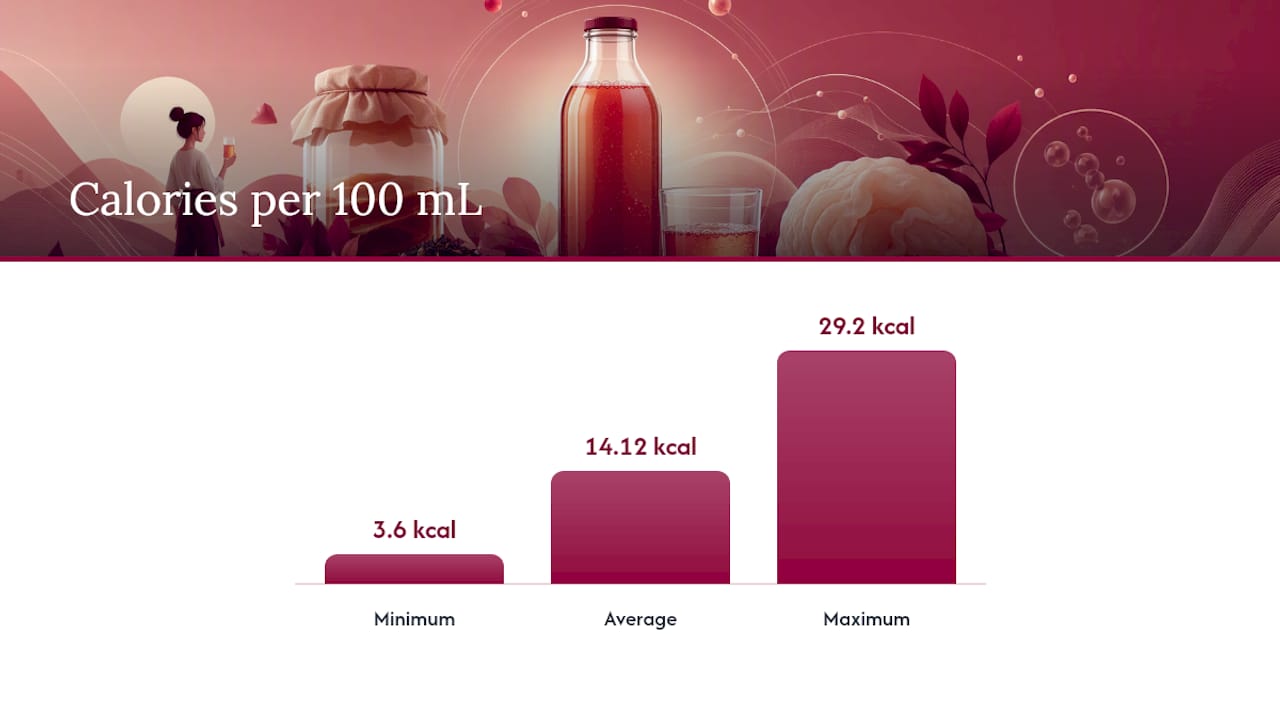
- Most kombucha averages around 14 calories per 100 mL, but the actual content can range widely from 3.6 to 29.2 kcal per 100 mL depending on fermentation and ingredients.
- Longer fermentation reduces residual sugar and calorie counts, while added fruit juices and syrups can significantly increase both.
- Comparing calorie counts between bottles requires adjusting for serving size and volume, as labels may not reflect the true intake if misunderstood.
- Kombucha typically contains less sugar and fewer calories than soda, but heavily sweetened or juiced versions can approach or exceed soft drink levels.
- For lower-calorie options, focus on plain or minimally flavored kombucha and check sugar content per 100 mL rather than relying solely on marketing claims.
Table of Contents
- Kombucha Calories Per 100 mL and Per Serving: What the Label Actually Shows
- Why Two Kombucha Bottles Can Have Wildly Different Calorie Counts
- How Kombucha Calories Stack Up Against Soda and Juice
- Does Kombucha Help With Weight Loss?
- How to Pick a Lower-Calorie Kombucha at the Store
- What Aboocha’s Approach to Lower-Sugar Kombucha Looks Like
- The Nutrition Label Tells You More Than the Marketing Does
- Try a Lower-Sugar Kombucha Built Around Flavor, Not Syrup
- Sources
- FAQ
Kombucha Calories Per 100 mL and Per Serving: What the Label Actually Shows
Numbers on a kombucha nutrition label swing more than most drinkers expect. A survey of commercial kombucha products found calories per 100 mL ranging from 3.6 to 29.2 kcal, with an average around 14.12 kcal. Per serving, that translated to a range of 15 to 100 kcal, based on an average bottle size of 352 mL. Sugar followed a similarly wideband: 0.2 to 6 grams per 100 mL, or roughly 1 to 24 grams per serving depending on the brand.
That “sugar” figure on the label usually lumps together sucrose left over from the tea, plus glucose and fructose produced during fermentation or added back through juice and flavoring. It is not one clean number tracking one clean ingredient.
Here’s how that plays out across real-world examples:
- Low end: A lightly fermented, unflavored kombucha might land around 15 to 20 kcal per serving, with 1 to 2 grams of sugar.
- Average: Most mainstream bottles fall between 30 and 40 kcal per 8 fl oz serving, matching the 14 kcal/100 mL average found in product surveys.
- High end: Fruit-juice blends or heavily sweetened flavors can push past 80 to 100 kcal per bottle.
Average commercial kombucha calorie content: about 14 kcal per 100 mL. That is the number worth remembering when you’re scanning a shelf, since it gives you a baseline to compare against whatever bottle you’re holding.
Serving size adds another layer of confusion. An 8 fl oz serving equals about 240 mL, but most bottles on shelves run 250 to 355 mL, meaning the “per serving” number on the label might reflect more or less than a full bottle. Always check whether the label lists values per serving or per container before you do the math.

Why Two Kombucha Bottles Can Have Wildly Different Calorie Counts
Fermentation length is the biggest lever. Shorter fermentation leaves more residual sugar from the original tea, which raises both sugar and calorie counts. Let it ferment longer, and the yeast and bacteria consume more sugar, dropping calories but usually adding tartness.
A few other factors shift the numbers just as much:
- Added fruit juices, syrups, or concentrates can double or triple calorie content compared to a plain base.
- Alternative sweeteners like stevia or erythritol lower calories, but check the label since these ingredients get counted differently than natural sugars.
- Packaging format matters more than people assume. Analytical surveys have found that canned kombucha often runs slightly lower in calories and sugar than the same brand’s glass-bottled version, likely tied to formulation choices made for shelf stability.
- Marketing labels can obscure real intake. A “per bottle” claim on a 355 mL can looks very different from a “per 100 mL” claim on a 500 mL bottle, even if the underlying recipe is identical.
Pro Tip: Don’t just compare calorie numbers between two bottles. Compare calories per 100 mL first, then multiply by the actual volume you plan to drink. It’s the only way to catch a “lower calorie” label that’s hiding a bigger serving size.
How Kombucha Calories Stack Up Against Soda and Juice
Regular cola averages about 39.5 kcal per 100 mL, with roughly 10 grams of sugar in that same volume. Kombucha’s average of 14 kcal per 100 mL puts it well under that, and its typical sugar content (around 3.17 g per 100 mL) runs about a third of cola’s.
That gap explains a lot of kombucha’s reputation as a “healthier soda swap.” But averages hide outliers.
- Some kombuchas exceed typical low-calorie soft drink territory. A heavily juiced or double-fermented bottle can reach up to 120 kcal, closer to a small glass of orange juice than a diet drink.
- Diet sodas still win on raw calorie count if that’s your only metric, since most sit near zero calories. Kombucha’s advantage is nutritional complexity, not calorie minimalism.
- Plain, lightly fermented kombucha beats regular soda on both sugar and calories in the vast majority of side-by-side comparisons.
The takeaway isn’t “kombucha is always lower calorie.” It’s “kombucha is usually lower calorie, but check the specific bottle before assuming.”
Does Kombucha Help With Weight Loss?
Not directly, and the research backs that up. Systematic reviews of kombucha clinical trials describe the existing evidence as limited and inconsistent, with small sample sizes and wildly different formulations from one study to the next. Some trials report mild shifts in metabolic markers; others find nothing meaningful. Nobody has produced strong evidence that kombucha burns fat or triggers weight loss on its own.
What kombucha can do is replace a higher-calorie drink in your day. Swap a 150-calorie soda for a 30-calorie kombucha and you’ve cut real calories, but that’s substitution math, not a metabolic effect. One clinical trial formulation used a pasteurized kombucha beverage with added inulin and B vitamins that delivered just 13 kcal per 100 mL, proving low-calorie versions exist, though that specific formulation was built for a study, not sold on shelves.
Practical rules that actually help:
- Treat sweetened or juice-flavored bottles as occasional treats, not daily staples.
- Log the sugar grams per serving, not just the calorie count.
- Use kombucha as a soda replacement, not an addition on top of your normal drinks.
- Cap intake around one bottle daily if you’re watching sugar closely; the FDA generally recognizes kombucha as safe in moderate amounts, but moderate is the operative word.
How to Pick a Lower-Calorie Kombucha at the Store
Reading a kombucha nutrition label takes about ten seconds once you know what to check.
- Check the serving size first. A label showing “60 calories” per 120 mL serving means a full 355 mL can holds closer to 175 calories.
- Convert to your actual pour. If you’re drinking the whole bottle, multiply the per-serving number by however many servings it contains.
- Read the sugar grams, not just the calorie total. Two bottles with matching calories can have very different sugar profiles depending on added sweeteners.
- Scan the ingredient list for juices, syrups, or concentrates. These almost always mean higher sugar and calories than a plain or lightly flavored version.
- Favor plain or subtly flavored kombucha, or brands built around non-nutritive sweeteners, when your goal is minimizing added sugar.
At home, a kitchen scale or a measuring cup takes the guesswork out of “one serving.” Most calorie-tracking apps let you log kombucha by milliliter rather than by bottle, which solves the serving-size mismatch problem for good. For flavor-specific guidance, Aboocha’s flavor guide breaks down which profiles tend to run lighter.
What Aboocha’s Approach to Lower-Sugar Kombucha Looks Like
Aboocha builds its kombucha around a lower-sugar formulation from the start, rather than diluting or reformulating after the fact. Flavors like Sour Plum and Yuzu Osmanthus deliver distinct taste without leaning on the syrups and concentrates that push other brands’ calorie counts higher.
Beyond the bottle, Aboocha publishes ongoing education on fermentation and gut health, including:
- How SCOBY fermentation affects sugar breakdown and flavor development.
- Why low-sugar fermented beverages tend to support gut health more consistently than sweetened alternatives.
- What lower sugar actually means for adults trying to balance flavor with nutrition goals.
The Nutrition Label Tells You More Than the Marketing Does
Most kombucha marketing leans on vague wellness language: gut health, probiotics, “ancient fermentation.” None of that tells you whether the bottle in your hand has 20 calories or 100. The label does, and it takes ten seconds to read.
What’s overrated in this conversation is the idea that kombucha, as a category, is automatically low-calorie or automatically better for weight management. It’s neither, categorically. It’s a beverage type with an enormous range, and the only way to know where a specific bottle falls is to check the per-100 mL numbers, not the front-of-package branding.
What’s underrated is fermentation length as a lever. Longer fermentation genuinely does reduce residual sugar, and that mechanical fact matters more than most sweetener debates. If you’re choosing between two bottles and only have ten seconds, skip the ingredient panel and go straight to sugar grams per 100 mL. That single number tells you more than anything else on the package.
Prioritize consistency over perfection. One lower-calorie kombucha a day, chosen deliberately instead of grabbed on impulse, beats obsessing over exact figures while still reaching for the juiciest, sweetest option on the shelf.
— Luna
Try a Lower-Sugar Kombucha Built Around Flavor, Not Syrup
If you’ve made it this far checking labels and comparing sugar grams, you already know most kombucha brands lean on fruit concentrates to mask a thin fermentation. Aboocha takes the opposite approach: lower sugar content by formulation, not by dilution, paired with flavors like Sour Plum and Yuzu Osmanthus that don’t need a sugar crutch to taste distinct.
Every bottle is built for readers who want the gut health benefits of real fermentation without the calorie surprises common in sweetened, juice-heavy competitors. A subscription plan makes it simple to keep lower-sugar kombucha on hand without re-checking labels every time you shop. Head to Aboocha’s kombucha lineup to see current flavors and start a subscription that fits how often you actually drink it.
Sources
Calorie and sugar ranges above come from a commercial kombucha product survey, a systematic review of clinical trials, and analytical supplementary data on kombucha products.
This article is general information, not a substitute for advice from a qualified doctor. Consult a qualified healthcare professional about your own circumstances before acting on anything here.
- Current Trends in Kombucha: Marketing Perspectives and the Need for Improved Sensory Research
- Benefits of kombucha consumption: systematic review (PMC article)
FAQ
Can I drink kombucha for weight loss?
Kombucha isn’t a proven weight-loss tool on its own; clinical trial evidence remains limited and mixed. Any calorie benefit usually comes from swapping it in for higher-calorie drinks like soda or juice.
Is kombucha too high in sugar?
Some bottles are, especially fruit-juice blends that can reach 6 grams of sugar per 100 mL. Plain or lightly flavored versions typically stay well under 2 grams per 100 mL, so the answer depends entirely on the specific product.
How is kombucha so low in calories compared to soda?
Fermentation converts much of the original tea’s sugar into acids and trace alcohol rather than leaving it as sugar calories, which is why kombucha averages around 14 kcal per 100 mL versus cola’s roughly 39.5 kcal per 100 mL. Brands with shorter fermentation or added juice run higher than that average.
Is kombucha actually healthy for you?
Kombucha is generally recognized as safe in moderate amounts and offers lower sugar and calories than most sodas, though health claims beyond that remain under-researched. Choosing a lower-sugar formulation, like those built around Sour Plum or Yuzu Osmanthus flavors, gets you the fermentation benefits without the added sugar load found in juice-heavy competitors.